The Evolution of The Scorpion God – Soul Baring Work
The Mother Temple has put out several semi-deluxe releases of late, each one a stunning bit of work in its own right.
It was only around last Samhain that I put up a short post here singing the praises of the recently released Beyond Akasha semi-deluxe edition of The Red King.
Thanks to a gruelling bit of graft by the Mother Temple, we’ve now also been blessed with a Beyond Akasha edition of The Scorpion God.
Having had a good week or two to go through the essays and work directly with the Book itself, I feel in a solid place to offer my own thoughts on what strikes me as a definitive edition of an already ground-breaking work.
The pictures taken in this blog post are taken by my wonderful assistant, as we wanted some pictures of our own copy here.
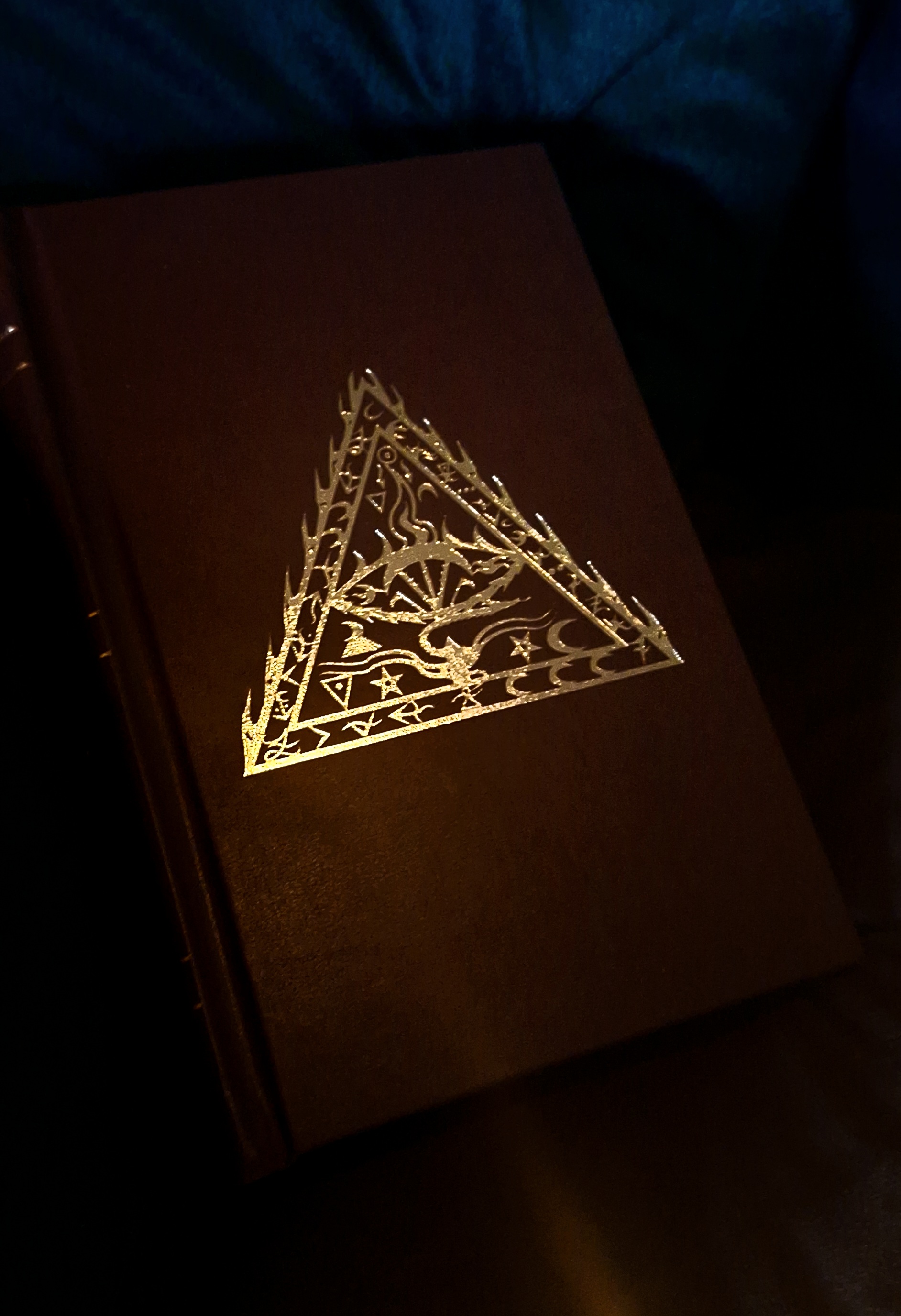
The Front Seal of The Book
Fit for a King — The Physically Embodied Book of Belial
The physical book itself is nothing short of pure luxury. I’ve been fortunate enough, both financially and proximity-wise, to pick up many Primal Craft publications. In my possession is a set of first editions of the Trident Trilogy, along with many of the Volumes of Sacrifice. These sit alongside several deluxe editions of various works — one of my favourites being the truly extravagant copy of The Crown Prince, bound in golden snake-skin.
That said, somehow this supposedly semi-deluxe book still manages to feel in a different league. Its construction is nothing short of exquisite, and it radiates a dense, energetic signature that can be felt even by the uninitiated. Simply put, the book has a commanding presence in the room.
Whilst I’m partial to the ye olde black book of witchcraft, I have a soft spot for editions that bring a rich colour to the table — both literally and figuratively. The earthy brown tones, set against gold foil, combine with evocative seals to instantly draw the eye. The quality of the paper, ink, sigilisation, and binding is second to none, even compared to past offerings. The ink itself is unbelievably thick and potent, the illustrations acting as gateways to the eye, pulling the reader in.
This is certainly the exact opposite of a ‘dead text’ — the whole thing feels palpably alive, inside and out. It begs to be touched, read, and interacted with.
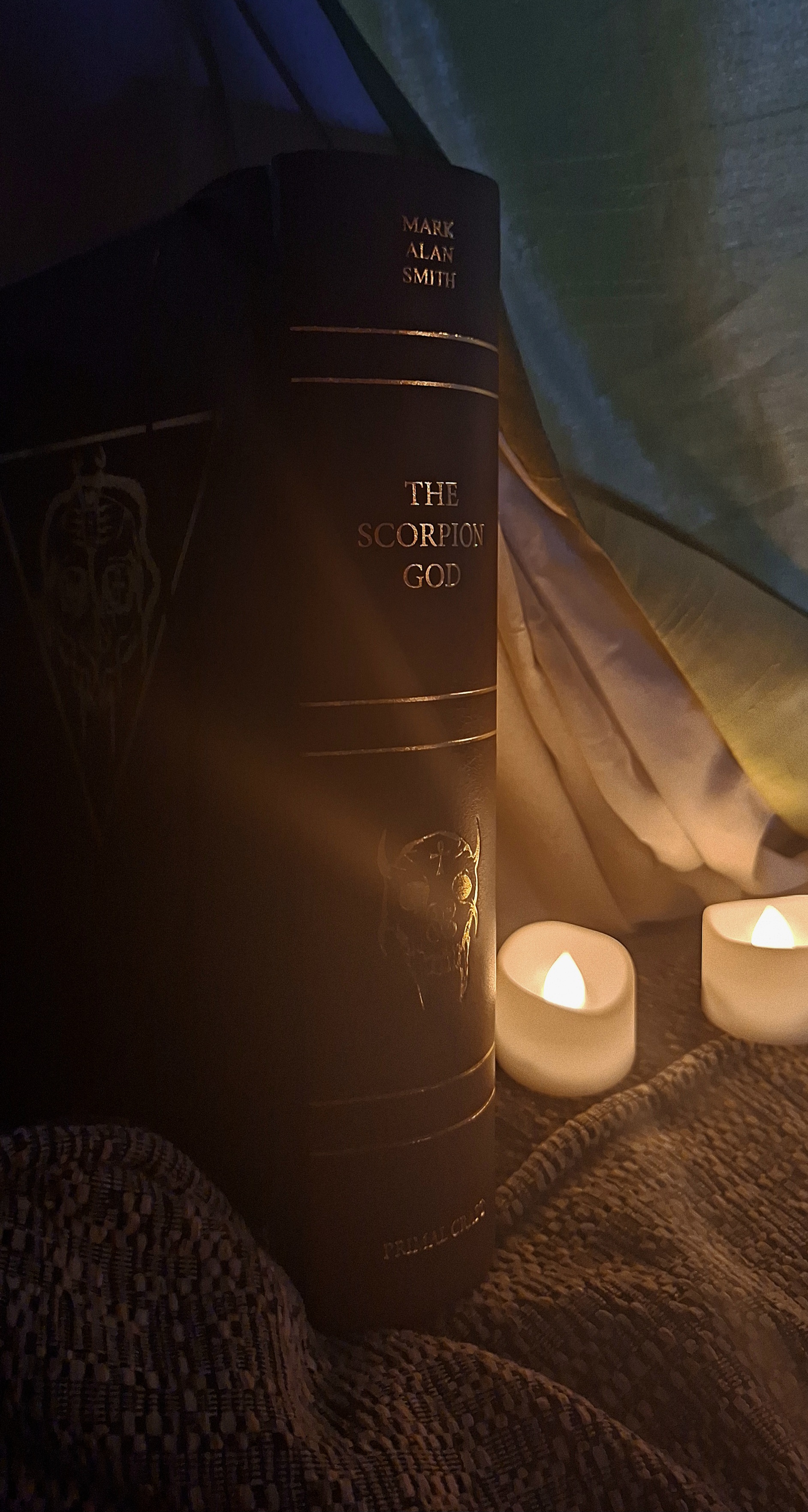
The Spine of The Book
The Scorpion Familiar of the Work
Before I tackle the extremely important additions to the text itself, I feel I must first briefly relate my own direct working with the book. Each individual copy of this edition, it is said, comes powerfully ensouled with an attached Scorpion Familiar.
The circumstances of my own copy’s arrival seemed to necessitate working with this spirit. It was a compulsion — quite simply, an urge that hadn’t accompanied similar gateways previously woven into past works.
As such, the instructions given for this were carried out to the letter: blood placed within the blank area beneath the number, and to the left of the scorpion’s stinger seal on the back pages. A personal call to Belial to release the Scorpion Familiar was made. This was granted, and the being came forth into my aura. Needless to say, the power released was immense, exceeding expectations. It verified for me the presence of the Scorpion Familiar within the work itself beyond a shadow of a doubt — as I physically saw it come through the opened vortex within the book.
The physical strength brought on by the possessive merging with this Scorpion is something I’ve yet to experience elsewhere in my work. To be clear — it had a tangible effect on my body, flooding it with vitality and supercharging its capacity for regeneration. This wasn’t something I had anticipated, for I had called it forth primarily to unblock certain ways and guard the temple space specifically. Nevertheless, it was a highly welcome side effect.
I won’t dwell too long on the personal side — to keep silent, after all, is an axiom — but I offer this to demonstrate that the book itself can be utilised as an important ritual tool. This is but one of the ways laid out somewhat openly for practitioners to engage with.

The Introductory Page to the New Content
Old and New — Ground-breaking Content
The original Scorpion God text, to me, will always be a timeless classic. When I first perused it, it was a confrontational read in many respects — as at that time in my practice, I was frankly extremely sceptical of the Atlantean connection. By the time I’d reached the end, I was fully convinced. The sheer depth, the palpably lived experience of travelling that path and putting it to paper was, to be frank, compelling. It opened up a huge universe of exploration within my own work, from a gnosis perspective alone — as it provided the core context that filled out the requisite picture of the current as a whole.
Heading into the semi-deluxe edition, I kept that experience firmly in mind. It was a joy to see the original text preserved in full. And it’s joined, in my view, by some extremely important additions — each worthy of individual comment. My original intention was to give a general overview, but to do so would be a disservice to these entries.
The Wisdom of Belial: Forging the Soul in the Realm of Atlantean Gods
The essays open strongly with clarifications on Belial’s true nature, as well as the hidden, occult purpose of the text itself. Of particular importance to me is the further explanation, spelled out in black and white, that the very planet itself is the Flesh of Belial.
This is major. Whilst this was explored more fully in the Volumes of Sacrifice, having that context placed back solidly into The Scorpion God, alongside a deep explanation of the formation of the Four Pillars of Fire — how and why it was channelled, earthed, and brought forth in this way — is absolute gold.
For those who like to dig deep, there’s a good deal of important Primal Craft-specific gematria scattered through this, which is explicitly touched on in the following essay.
Atlantean Devil Queen
This essay is a thorough examination of the nature of Sepheranz and how to safely approach her.
I honestly feel this is an essential addition — clarifying Sepheranz’s role, importance, nature, and history within the current. Whilst this was covered at length in Volumes of Sacrifice, having it so clearly laid out within The Scorpion God offers a perfect counterbalance to the raw, primal face of her that we see in the parent text. We get to witness the many facets that make up this beautiful, terrifying goddess.
But that’s not all — here we also find what I believe to be the most concise and complete account of the history of creation within the written Primal Craft tomes. As such, it feels like an invaluable contribution in its own right, placing the lost history into full context. This alone would make it a standout entry for me.
Personally, I understand how intimidating she can be to work with. For many years, in fear, I avoided working with her until I one day felt compelled to place her blooded seal upon my altar. It felt simple it was no longer appropriate to deny her a place within my growing praxis.
The advice offered here — to first approach her more exoteric (but still ferocious) face as the Daughter of War, Conquest and Flame — and the exposition given on that aspect will, I think, be a great help to many who, like me, harboured an earlier fear of incorporating her into their craft. This is essential for fully working the current.
There’s also a fine exploration of Primal Craft gematria here, particularly detailing the Formula of the Apocalypse at both macro and microcosmic levels. This deserves to be thoroughly read, understood, and applied in praxis.
Faces of a King
I first read Faces of a King many years ago in the original Devoted, and it’s a pleasure to see it returned to the Primal Craft fold. This fascinating essay shows the early stages of Mark’s work with Belial. In contrast with the main text, it offers valuable insight and brings a large humanising element — something that extends to all these clearly deeply personal revelations.
This particular entry does much to dispel misconceptions about Belial’s supposed ‘malicious’ nature — revealing such an angle as absurd, as the Great King facilitates a deeply primal form of justice. The essay is aptly named, as we’re treated to many multifaceted faces of Belial here, figuratively and literally.
There’s also some excellent detail on the Moires (the Fates), which I think will be of great use to the devotee. For those able to read between the lines, it also reveals important aspects of the arte of evocation — and why in our craft, we do not pursue the ‘force and coercion’ method of evoking.
This text had a profound impact on me as a much younger man, and it became the spur for creating my own evocation ritual to contact this great entity directly. I’ve never regretted it.

The Immortal Flesh, detailing work with the Book of the Dead, pg 328
The Amber Chamber
If Faces of a King served as preparation, the next two essays are, in my view, some of if not the rawest and most soul-baring ever put to paper in our current.
The Amber Chamber is a deep dive into the Atlantean God Lommos and his first encounters with the author. It reveals the side effects of what is, frankly, soul-transformative work at the highest level, while also making public, for the first time, the Temple High Priestess of our Arte, detailing her critical role. That alone would mark this essay out as special — but combined with the full Atlantean context, it becomes nothing short of revelatory.
The Temple High Priestess’ harrowing experience with Lommos forms the core of this piece, unfolding rapidly in a manner both raw and confronting. The essay first details the preconditions for the event it describes — the formation of the bloodstone gate and the shattering of the amber stone in consequence. For those seeking to more fully grasp the implications of the Phoenix Rite and its completion, this is essential reading. Compared to the relevant entry in Queen of Hell, it provides invaluable formulae.
The description of the testing on the Path of the Red Snake leads us into conflict against the arising Atlantean power. The implications of the Lore of Atlantean Magick being bypassed become chillingly clear — and Belial necessarily steps forward. Once again, we gain greater insight into this Witch God, specifically regarding a particular taboo, and how his role as protector and guide proves absolutely critical. We learn much here about the nature of Lommos himself and, by extension, the Gods of the Atlantean plane.
There’s a vast amount to unpack — far too much for a few paragraphs. Those able to read between the lines will discover much about the nature of reverse evocation, among other advanced occult practices. As an aside, there’s a small but valuable section detailing the nature of Cerberus, including the use of his seal in copper for the sealing of gates and protection. For those truly paying attention, this essay offers much to improve general working praxis.
The Eldorath
This essay recounts Mark’s meetings with one of the Eldorath, the Daughters of Sepheranz, and the extreme soul-testing he underwent as part of that encounter. Truthfully — after reading it, I wasn’t sure what to write. The previous essay had already struck an emotional chord; this one left me silent. It wasn’t a choice.
The implications are, frankly, extreme. We’re treated to a discourse revealing the multiplicity of the soul’s nature and its existence across time. While we witness glimpses of its resilience, we’re also shown how fragile it truly is when exposed to the sheer power of this entity — who, on the path of soul testing, can exploit that structure as a single point of failure, if deemed necessary, with horrifying consequences. The nature of the Daughters of Sepheranz is covered in revealing detail, offering further insight into the trials of working within the realms of Tiranar.
If there was any lingering doubt, this essay underscores the real risk involved — genuine power is attained only through genuine sacrifice, offered up in love and devotion, one way or another. This is not the work of mental gymnastics but direct work on the Atlantean Inner Planes — with no do-overs.
The section describing Lucifer’s fire struck me deeply. I’ve yet to experience anything remotely as confronting on my own journey (and hopefully, never will), but it spoke to me nonetheless. One ember can be all the blessing one needs.
There’s little more I can say — this is something that simply must be read and experienced. Which, I feel, is what can be said for this excellent tome as a whole.

The Final Seals of the Book
When choosing which artwork to feature here, which are improved over the original first editions massively in richness, I chose the image of The Immortal Flesh to highlight the quality on display. This piece has always called to me – the haunting, Atlantean landscape and the shades have always stood out in my mind amongst many memorable images.
Finally, but not least – when taking pictures of the book, a small oracular work was performed to dictate the final page that would be shown in this article, what the work itself wanted to show. The book once asked, opened on the page of The First Altar of the Witch Gods.
I feel this is a perfect way to end this little / review / analysis / whatever the reader wishes to call it. I feel deeply grateful to be able to have this work in my collection, and may it for many years guide myself, and those who work the current here, bathing us in the Primal Current.

The First Altar of the Witch Gods
In Nomine Belial,
We Walk The Path of the Setting Sun,
~S~
 The Luciferian Revolution
April 16, 2025 at 8:35 am
That was a beautiful and worthy in-depth review of the book. A lot of hard work went into this tome so thank you for your appreciation of it here.
Best
In Nomine Hecate,
Mark.