Archive for Spirituality

Devolution in the Occult – From Kenneth Grant to Modern Occult Amnesia

Posted in Occultism, Publications with tags , , , , , , , , , , , , , , , on November 22, 2025 by Sypheara

It was very quiet Samhain here, where we instead chose to focus on a local ritual and our private practice which continues to expand in depth. This year I have not felt particularly social because I have found that focusing on the more closed aspects have borne the most fruit.

Recently I have had a rare chance to relax and actually hit the books again so to speak from an Occult perspective. The series I’ve decided to dive back into again and go over thoroughly is none other than the Typhonian Trilogies by Kenneth Grant, which are thankfully still being published by Starfire Publishing.

This has been a rather illuminating experience; I first read these books when I was in my very early 20’s, and simply on reflection I did not have the required magickal grounding to truly understand them or their impact.


Nightside of Eden, Kenneth Grant, Starfire Publishing

Looking back on these works fifteen or so years later, what I have gotten from these works have only increased, in particular so far Nightside of Eden. Truly, Grants work was ground-breaking – as the first person to fully formulate a contemporary western left hand path (and outside Primal Craft, in my opinion the most pure inheriting from earlier magical roots) as well as the first to properly analyse the dark side of the Tree of Life. In many ways, he went beyond Crowley – who made reference to the Qliphoth and related daemonic entities (like Choronzon), but did not publish a complete book detailing the entire Tree of Death.

For those not familiar with Grant, he was a British occultist and writer best known for expanding and reinterpreting the work of Aleister Crowley, blazing the way for something truly new. A student of Crowley’s, Gerald Gardner’s associate, and briefly head of the O.T.O.’s British branch to name but a few things, Grant developed a distinctive, highly imaginative system that blended Thelemic magic with influences from Tantra, Western esotericism, Afro-Caribbean traditions, and cosmic horror. His major contribution was the Typhonian Trilogies, a series of books exploring themes of “spectral” realities, the Nightside of the Tree of Life, and the idea that occult forces interact with the human psyche in ways stranger and more complex than occultists of the time detailed.

He went on to found the Typhonian order, what was originally the New Isis Lodge later became the Typhonian Ordo Templi Orientis (TOTO), which Grant founded to develop these ideas. It is still in existence today as simply the Typhonian Order and emphasizes visionary, trance-based, and dream-based exploration of occult realms, particularly those associated with the ancient Egyptian goddess Typhon/Typhon-Set symbolism and the Nightside of the Kabbalistic Tree. Although controversial within the broader Thelemic world, Grant’s Typhonian tradition remains influential among practitioners interested in the more surreal, psychological, and cosmic dimensions of occultism. Whilst this is a simplification in many areas, it will have to suffice for this article.

As this out of the way, I was rather shocked when I went online to look into what others thought of these seminal works and this great occultist. Not only does it appear that the majority of people have forgotten Grants contribution to the Western Left Hand Path and Occultism in general, but rather the vast majority of conversation seems to be of a disparaging nature. One ‘standout contribution’ goes as follows:

‘Frankly, I think Grant is crazy as hell / mad as a hatter. He is sex obsessed and his Gemetria is whack. He distorts numbers and names to fit his own ideas. Everything is apparently a symbol of Set. He perverts the symbols of occultism for his own philosophy. His work just has an aura of perversity to me.’ – Nau7ik

I choose this particular example because its rather illustrative of the kind of rot we see in the modern occult ‘sphere’ ( I refuse to call it a community at this stage, and doubt that really ever applied ). These are big words from an anonymous nobody with no skin in the game, contrasted against Grant who is recognised as stand out author and occultist who pathed the way for people such as Thomas Karlsson amongst others in the latter 20th century and beyond to engage closely the Tree of Death. Whatever the reader personally thinks of those authors, no one can doubt that without Grant, one can easily posit their work may never have come to fruition.

Kenneth Grant

The position above shows a profound ignorance of material that came before; The comment that Grant was sex obsessed alone shows a complete lack of underlying magickal training and comprehension, and certainly of Grants specific tantric background and training. The return of the sexual magickal current is absolutely fundamental to the remeshing of witchcraft and ceremonial magic – something that has been illuminated by our own Primal Current amongst others. It is almost as if the reader has had an encounter with the uncomfortable and baulked, in fear, as the Abyss looks back. In that way, Grant definetly succeeded; for walking the branches of The Tree of Night and crossing the Abyss is certainly not meant to be a comfortable affair. The irony of the Abyss being the pass-me-not of Knowledge is certainly expressed here.

What is left of the critique fails to understand the symbolic language at play, and one wonders how much credence we can give to someone who does not understand Gematria (never mind it appears, spell it correctly). Grants Gematria is used as vehicle for gnosis, not a simple dull tool, but to draw syncretic, meaningful connections using the language available in the tradition he was trained. His nonlinear, almost dreamlike associations combine to saturate each sentence with heavy, cohesive meaning that seems to drip from the page. In fact his body of work is so dense, many of those who later cherry picked from his books (often without attribution, another painful way that we forget our forebears) missed out certain very key elements of his work which went far beyond simply revealing the structure and makeup of what he describes as ‘Universe B’.

One of the constant criticisms of Grant is his focus on extra-terrestrial intelligences – those that lie beyond what Grant would call the ‘Trans Plutonic Power Zones’. Putting aside the disturbing premonitory drawings of Crowley of the spirit LAM (which predates UFOLOGY by decades), it is clear that Grant is talking about beings from the Outside of the Tree. Seen in contrast to our own tradition, it is clear Grant and others he talks extensively about were indeed knocking on a forbidden door, that which others could not see and which at that point, they were not quite granted the keys to access. This gives credence to why Grant is obsessed with these entities and attempts to establish two way communication.

At this point this post could be simply seen as a rant against one very poor take, so I need to take a moment to reiterate I am using this as an example – for it is reflective of a common attitude held by so called modern occultists. They can no longer be bothered to analyse a work in depth – to seek its merits, as well as its weaknesses. To engage with it at a deep level and actually analyse it. In our modern era everyone wants an easily digestible spirituality – something which is completely at odds with the inherent necessity of the innate challenge, paradox, and obscurity in genuine occult paths. Historically, practitioners often were not even allowed to engage with certain texts until initiated precisely because it required the mindset to be instilled so that they could be effectively understood and integrated. Now, people want it delivered in the span of a single webpage.

One of the most overlooked aspects of genuine occult practice is the requirement for patient study, that builds on foundational knowledge over a period of time. An intellectual and spiritual stamina that stands in stark contrast to the culture of immediacy that now dominates esoteric discourse. The older occult authors, including Grant, assumed without question that the reader would spend years grappling with symbolic density, ambiguity, and the deliberately circuitous nature of initiatory texts. This was not done to obscure knowledge for elitism’s sake, but because certain currents simply cannot be digested in a single reading or through the lens of casual curiosity (see the closing statement of this post for Grants own take). They require repeated exposure, contemplation, and gradual internalisation. The modern seeker, conditioned by rapid-fire media and constant novelty, often lacks the patience required for this slow alchemy of understanding. As a result, the deeper strata of meaning within these works are dismissed as “confusing,” “mad,” or “overly abstract,” when in reality they are structured to reveal themselves in layers corresponding to the reader’s level of attainment. The mysteries have always operated this way. The text changes because the practitioner changes. Without this willingness to return, reflect, and wrestle with complexity, the doors that authors like Grant painstakingly opened remain shut, no matter how widely available the books become. Rereading this text myself after many years, I understand things with a new level of clarity.


Kenneth and Steffi Grant

The unfortunately reality today however is everything is expected to be delivered and consumed instantly (or near such). We live in a social structure where all information needs to be summarised and compressed into neat little paragraphs, or worse, into fifteen second long shorts shoved out as fast as possible by the likes of TikTok and Youtube. You simply cannot properly teach or explore theurgic, magickal concepts in such a format. Any attempt to crush complicated, occult philosophy into tiny matchbox sized videos will at best miss out critical pieces of information, or at worst, come out heavily mangled, misleading, and flat out incorrect.

As an example of informational rot, I recently saw a short on Facebook of all places, erroneously ascribing the Akashic Records to the lower Sephira on the Tree of Life. Anyone with experience and understanding of the Abyss and its role in the evolutionary history of Mankind, or even an inkling into what Grant would call the ‘Trans Plutonic Power Zones’, would know why this is decidedly, incorrect. But when it is said in such a self assured way, it is likely to believed as objective fact.

For clarity – if we were to map the Theosophical concept onto the Kabbalistic Tree (an imperfect but sometimes done comparison), the Akashic Records correlate more closely to Da’ath (as the gateway to transpersonal knowledge), the threshold of the Supernal Triad. An argument could be made even Ain–Ain Sof–Ain Sof Aur itself if one interprets the Records metaphysically rather than clairvoyantly. Our own tradition has other contenders. But that all aside:

They are emphatically NOT located in Yesod, Hod, or Netzach or their nightside equivalents which are the lower spheres tied to the psyche, astral imagery, and intellect. The Akashic Records, by definition, belong to the domain of transpersonal memory, which is precisely the kind of knowledge that cannot descend intact “below the Veil.” This alone makes the “lower spheres of the tree = Akashic Records” claim entirely incoherent.

Accuracy, sacrificed at the Altar of Ego by people who at best, make outlandish claims out of ignorance or worse, believe that there is no true, objective occult reality and resulting misinformation is a real concern. That things can be made up on the fly for views, clicks, and attention with an added purpose of sucking up money via Patreon accounts is a deeply disappointing use of the technology we have inherited from the likes of Sir Tim Berners-Lee who sacrificed profit to give us this gift of worldwide connection.

This is only going to be more of a problem as we now find ourselves truly in the Age of AI Slop. The problem with the proliferation of this nonsensical content will ensure these inaccuracies are surfaced over genuine information and regurgitated as gospel – new seekers will therefore not only be dealing with the manually produced misinformation, but also the discordant, schizophrenic AI content which will only further take them away from the true source. The algorithm selects those who can get attention, not those who put out accurate information – it lacks any and all discernment. I call this ‘Content Occultism’, for it concerns itself only with volume and not quality.

The irony is in a few decades, I believe this state of affairs will likely force people to return to trusted sources in hard print, and further validate the teaching practices of the traditional, initiatory mystery schools. Certainly, those genuinely seeking the Mysteries would be better served turning their attention to understanding the works of their predecessors – the Crowleys, Grants, Chumbleys, Gardners, Valientes and Williamsons to name a few and immerse themselves in the roots of the western magickal tradition, and keep well away from the mass generated informational noise. These are the people we should be discussing – the people who we should never forget, whilst we work within our own tradition. This is not a call to mix, match, and dilute our own practice. However we must know and understand our roots and place them in the context of our occult history.

It also shows we should show serious discretion with which current contributors in the Occult sphere we let influence our practice, for effectively they act as teachers in remote. A rotten tree will always bear rotten fruit. But by comparing what is, to what was, we can make much more informed decisions. The fact the world forgets people like Grant, whilst shovelling mud down the throats of those looking for genuine answers is a true travesty.

Furthermore, this does lead me into a bit of a prediction – I believe we are going to eventually come back full circle. The cults of the mystery traditions will again be the bastion of protecting the hidden secrets – because it will be the only place to find genuine, uncorrupted information. The book is going to win over the digital soup, and people will inevitably abandon the unreliable digital chorus and head back to the page, to truly delve deep into underlying metaphysical reality. This way, the undiluted knowledge can be accessed.

A special note I’d like to add in here is in regards to Steffi Grant, who was a prolific artist and occultist in her own right who was truly able to embody and enflesh the unknown. She was living proof that a machine can never put to paper the matters of the soul with the same heart as that of a spiritually awakened artist, and it was with great sadness I learned she had passed away some years ago.

He Shall Come, by Steffi Grant

On that note, I will sound off with the words of Kenneth himself, as he details the Mysteries in the Authors Foreword of Nightside of Eden:

”The keys of practical occultism, whether of Mysticism or of Magick, may be apprehended intellectually by the study of books, but it is on the inner planes alone that their effective workings may be revealed. Unless the requisite contacts on the inner planes are established in the manner, no amount of reading will disclose ‘secrets’ that are literally indecipherable and therefore truly occult. The safeguards are both automatic and fool-proof. – Authors Forward, Nightside of Eden

~S~
The Evolution of The Scorpion God – Soul Baring Work

Posted in Primal Craft, Publications with tags , , , , , , , , , , , , , , , , , , on April 15, 2025 by Sypheara

The Mother Temple has put out several semi-deluxe releases of late, each one a stunning bit of work in its own right.

It was only around last Samhain that I put up a short post here singing the praises of the recently released Beyond Akasha semi-deluxe edition of The Red King.

Thanks to a gruelling bit of graft by the Mother Temple, we’ve now also been blessed with a Beyond Akasha edition of The Scorpion God.

Having had a good week or two to go through the essays and work directly with the Book itself, I feel in a solid place to offer my own thoughts on what strikes me as a definitive edition of an already ground-breaking work.

The pictures taken in this blog post are taken by my wonderful assistant, as we wanted some pictures of our own copy here.

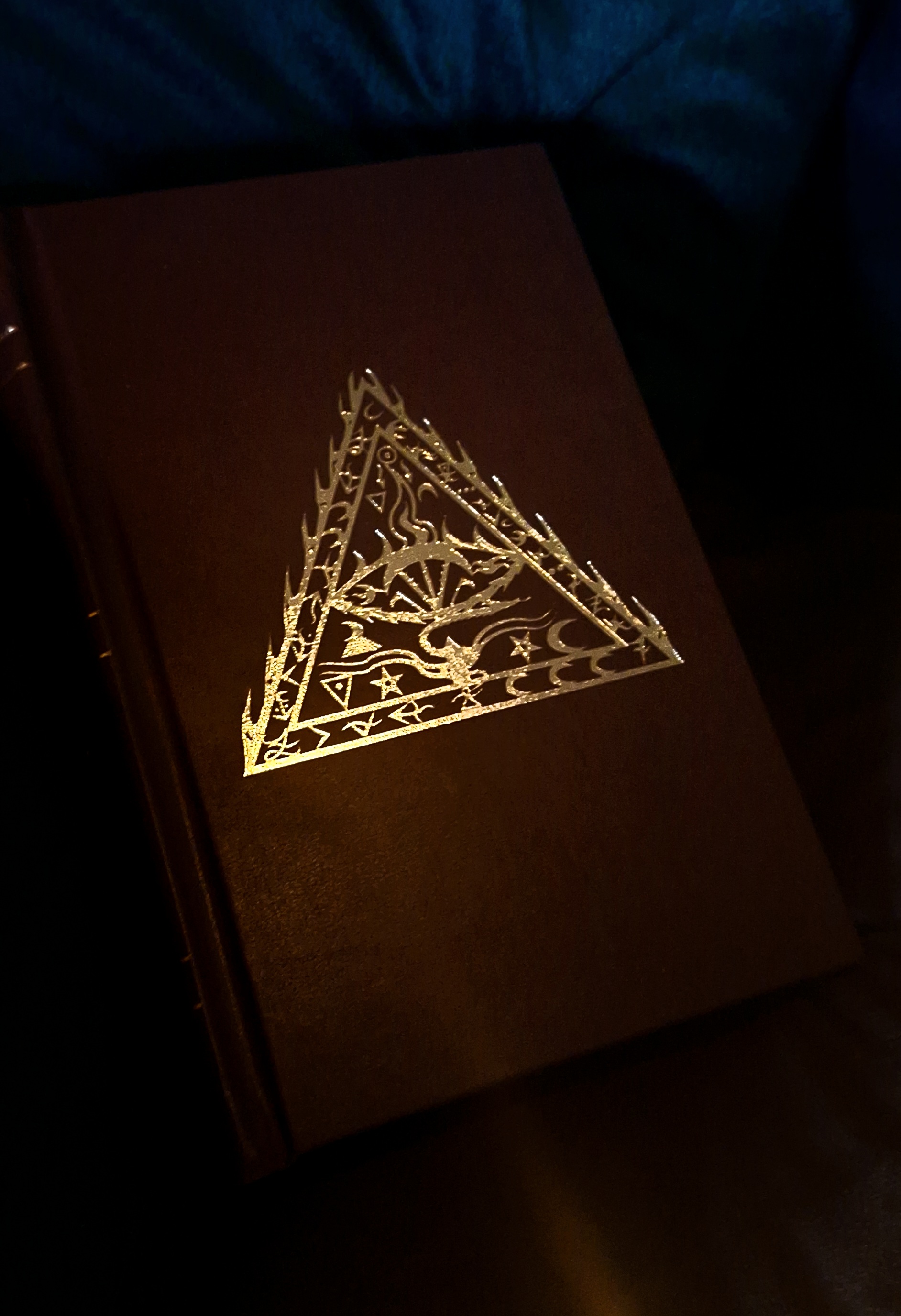
The Front Seal of The Book

Fit for a King — The Physically Embodied Book of Belial

The physical book itself is nothing short of pure luxury. I’ve been fortunate enough, both financially and proximity-wise, to pick up many Primal Craft publications. In my possession is a set of first editions of the Trident Trilogy, along with many of the Volumes of Sacrifice. These sit alongside several deluxe editions of various works — one of my favourites being the truly extravagant copy of The Crown Prince, bound in golden snake-skin.

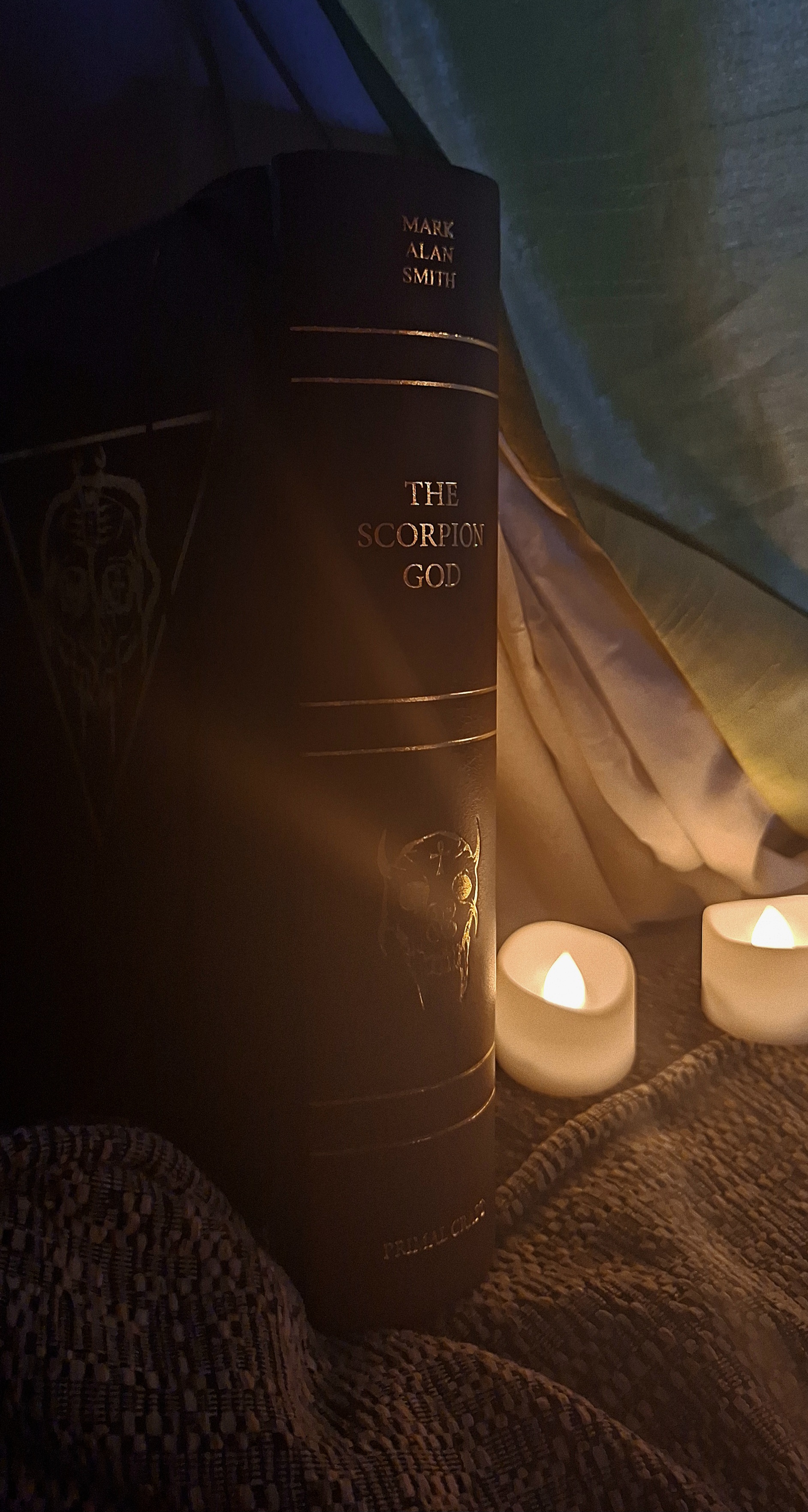
That said, somehow this supposedly semi-deluxe book still manages to feel in a different league. Its construction is nothing short of exquisite, and it radiates a dense, energetic signature that can be felt even by the uninitiated. Simply put, the book has a commanding presence in the room.

Whilst I’m partial to the ye olde black book of witchcraft, I have a soft spot for editions that bring a rich colour to the table — both literally and figuratively. The earthy brown tones, set against gold foil, combine with evocative seals to instantly draw the eye. The quality of the paper, ink, sigilisation, and binding is second to none, even compared to past offerings. The ink itself is unbelievably thick and potent, the illustrations acting as gateways to the eye, pulling the reader in.

This is certainly the exact opposite of a ‘dead text’ — the whole thing feels palpably alive, inside and out. It begs to be touched, read, and interacted with.

The Spine of The Book

The Scorpion Familiar of the Work

Before I tackle the extremely important additions to the text itself, I feel I must first briefly relate my own direct working with the book. Each individual copy of this edition, it is said, comes powerfully ensouled with an attached Scorpion Familiar.

The circumstances of my own copy’s arrival seemed to necessitate working with this spirit. It was a compulsion — quite simply, an urge that hadn’t accompanied similar gateways previously woven into past works.

As such, the instructions given for this were carried out to the letter: blood placed within the blank area beneath the number, and to the left of the scorpion’s stinger seal on the back pages. A personal call to Belial to release the Scorpion Familiar was made. This was granted, and the being came forth into my aura. Needless to say, the power released was immense, exceeding expectations. It verified for me the presence of the Scorpion Familiar within the work itself beyond a shadow of a doubt — as I physically saw it come through the opened vortex within the book.

The physical strength brought on by the possessive merging with this Scorpion is something I’ve yet to experience elsewhere in my work. To be clear — it had a tangible effect on my body, flooding it with vitality and supercharging its capacity for regeneration. This wasn’t something I had anticipated, for I had called it forth primarily to unblock certain ways and guard the temple space specifically. Nevertheless, it was a highly welcome side effect.

I won’t dwell too long on the personal side — to keep silent, after all, is an axiom — but I offer this to demonstrate that the book itself can be utilised as an important ritual tool. This is but one of the ways laid out somewhat openly for practitioners to engage with.

The Introductory Page to the New Content

Old and New — Ground-breaking Content

The original Scorpion God text, to me, will always be a timeless classic. When I first perused it, it was a confrontational read in many respects — as at that time in my practice, I was frankly extremely sceptical of the Atlantean connection. By the time I’d reached the end, I was fully convinced. The sheer depth, the palpably lived experience of travelling that path and putting it to paper was, to be frank, compelling. It opened up a huge universe of exploration within my own work, from a gnosis perspective alone — as it provided the core context that filled out the requisite picture of the current as a whole.

Heading into the semi-deluxe edition, I kept that experience firmly in mind. It was a joy to see the original text preserved in full. And it’s joined, in my view, by some extremely important additions — each worthy of individual comment. My original intention was to give a general overview, but to do so would be a disservice to these entries.

The Wisdom of Belial: Forging the Soul in the Realm of Atlantean Gods

The essays open strongly with clarifications on Belial’s true nature, as well as the hidden, occult purpose of the text itself. Of particular importance to me is the further explanation, spelled out in black and white, that the very planet itself is the Flesh of Belial.

This is major. Whilst this was explored more fully in the Volumes of Sacrifice, having that context placed back solidly into The Scorpion God, alongside a deep explanation of the formation of the Four Pillars of Fire — how and why it was channelled, earthed, and brought forth in this way — is absolute gold.

For those who like to dig deep, there’s a good deal of important Primal Craft-specific gematria scattered through this, which is explicitly touched on in the following essay.

Atlantean Devil Queen

This essay is a thorough examination of the nature of Sepheranz and how to safely approach her.

I honestly feel this is an essential addition — clarifying Sepheranz’s role, importance, nature, and history within the current. Whilst this was covered at length in Volumes of Sacrifice, having it so clearly laid out within The Scorpion God offers a perfect counterbalance to the raw, primal face of her that we see in the parent text. We get to witness the many facets that make up this beautiful, terrifying goddess.

But that’s not all — here we also find what I believe to be the most concise and complete account of the history of creation within the written Primal Craft tomes. As such, it feels like an invaluable contribution in its own right, placing the lost history into full context. This alone would make it a standout entry for me.

Personally, I understand how intimidating she can be to work with. For many years, in fear, I avoided working with her until I one day felt compelled to place her blooded seal upon my altar. It felt simple it was no longer appropriate to deny her a place within my growing praxis.

The advice offered here — to first approach her more exoteric (but still ferocious) face as the Daughter of War, Conquest and Flame — and the exposition given on that aspect will, I think, be a great help to many who, like me, harboured an earlier fear of incorporating her into their craft. This is essential for fully working the current.

There’s also a fine exploration of Primal Craft gematria here, particularly detailing the Formula of the Apocalypse at both macro and microcosmic levels. This deserves to be thoroughly read, understood, and applied in praxis.

Faces of a King

I first read Faces of a King many years ago in the original Devoted, and it’s a pleasure to see it returned to the Primal Craft fold. This fascinating essay shows the early stages of Mark’s work with Belial. In contrast with the main text, it offers valuable insight and brings a large humanising element  — something that extends to all these clearly deeply personal revelations.

This particular entry does much to dispel misconceptions about Belial’s supposed ‘malicious’ nature — revealing such an angle as absurd, as the Great King facilitates a deeply primal form of justice. The essay is aptly named, as we’re treated to many multifaceted faces of Belial here, figuratively and literally.

There’s also some excellent detail on the Moires (the Fates), which I think will be of great use to the devotee. For those able to read between the lines, it also reveals important aspects of the arte of evocation — and why in our craft, we do not pursue the ‘force and coercion’ method of evoking.

This text had a profound impact on me as a much younger man, and it became the spur for creating my own evocation ritual to contact this great entity directly. I’ve never regretted it.

The Immortal Flesh, detailing work with the Book of the Dead, pg 328

The Amber Chamber

If Faces of a King served as preparation, the next two essays are, in my view, some of if not the rawest and most soul-baring ever put to paper in our current.

The Amber Chamber is a deep dive into the Atlantean God Lommos and his first encounters with the author. It reveals the side effects of what is, frankly, soul-transformative work at the highest level, while also making public, for the first time, the Temple High Priestess of our Arte, detailing her critical role. That alone would mark this essay out as special — but combined with the full Atlantean context, it becomes nothing short of revelatory.

The Temple High Priestess’ harrowing experience with Lommos forms the core of this piece, unfolding rapidly in a manner both raw and confronting. The essay first details the preconditions for the event it describes — the formation of the bloodstone gate and the shattering of the amber stone in consequence. For those seeking to more fully grasp the implications of the Phoenix Rite and its completion, this is essential reading. Compared to the relevant entry in Queen of Hell, it provides invaluable formulae.

The description of the testing on the Path of the Red Snake leads us into conflict against the arising Atlantean power. The implications of the Lore of Atlantean Magick being bypassed become chillingly clear — and Belial necessarily steps forward. Once again, we gain greater insight into this Witch God, specifically regarding a particular taboo, and how his role as protector and guide proves absolutely critical. We learn much here about the nature of Lommos himself and, by extension, the Gods of the Atlantean plane.

There’s a vast amount to unpack — far too much for a few paragraphs. Those able to read between the lines will discover much about the nature of reverse evocation, among other advanced occult practices. As an aside, there’s a small but valuable section detailing the nature of Cerberus, including the use of his seal in copper for the sealing of gates and protection. For those truly paying attention, this essay offers much to improve general working praxis.

The Eldorath

This essay recounts Mark’s meetings with one of the Eldorath, the Daughters of Sepheranz, and the extreme soul-testing he underwent as part of that encounter. Truthfully — after reading it, I wasn’t sure what to write. The previous essay had already struck an emotional chord; this one left me silent. It wasn’t a choice.

The implications are, frankly, extreme. We’re treated to a discourse revealing the multiplicity of the soul’s nature and its existence across time. While we witness glimpses of its resilience, we’re also shown how fragile it truly is when exposed to the sheer power of this entity — who, on the path of soul testing, can exploit that structure as a single point of failure, if deemed necessary, with horrifying consequences. The nature of the Daughters of Sepheranz is covered in revealing detail, offering further insight into the trials of working within the realms of Tiranar.

If there was any lingering doubt, this essay underscores the real risk involved — genuine power is attained only through genuine sacrifice, offered up in love and devotion, one way or another. This is not the work of mental gymnastics but direct work on the Atlantean Inner Planes — with no do-overs.

The section describing Lucifer’s fire struck me deeply. I’ve yet to experience anything remotely as confronting on my own journey (and hopefully, never will), but it spoke to me nonetheless. One ember can be all the blessing one needs.

There’s little more I can say — this is something that simply must be read and experienced. Which, I feel, is what can be said for this excellent tome as a whole.

The Final Seals of the Book

When choosing which artwork to feature here, which are improved over the original first editions massively in richness, I chose the image of The Immortal Flesh to highlight the quality on display. This piece has always called to me – the haunting, Atlantean landscape and the shades have always stood out in my mind amongst many memorable images.

Finally, but not least – when taking pictures of the book, a small oracular work was performed to dictate the final page that would be shown in this article, what the work itself wanted to show. The book once asked, opened on the page of The First Altar of the Witch Gods.

I feel this is a perfect way to end this little / review / analysis / whatever the reader wishes to call it. I feel deeply grateful to be able to have this work in my collection, and may it for many years guide myself, and those who work the current here, bathing us in the Primal Current.

The First Altar of the Witch Gods

In Nomine Belial,
We Walk The Path of the Setting Sun,
~S~

A Warm Welcome

Posted in Luciferianism, The Path of Flames with tags , , , , , , , on May 7, 2013 by Sypheara

Well here it is, the blog I thought I’d never make. I don’t usually enjoy talking about myself or my practice, due to the baggage that it inevitably brings, but after much encouragement I finally decided it was time to bite the bullet. I hope many of you will enjoy what I have to share!

Firstly, I have completed a basic about page which can be found in the navigation box on the right. For those of you who don’t personally know me, I hope it will suffice as an introduction as to what this blog is about and my own personal experience up to this point on my path. It was alot to try and fit into a reasonable word count, as I believe it’s important for people to know my general background to find what I write more approachable. I don’t like pretentiousness or the focus on the individual over ideas which can be the case within the Pagan/Occult community in some places, so I hope it comes across as frank and honest as possible.

Many of you may be wondering why I have chosen the name The Luciferian Revolution for the blog. After all, isn’t this a blog on Pagan things and clearly Lucifer is a christian construct and idea?

A valid question I would say. The long answer would be too long to explain in the introductory post, but the short answer is a definite no.

Lucifer was the name refering to an earlier Roman/Greek concept based around the gods Phosphorus and Hesperus, themselves personifications of the morning and evening appearances of the planet Venus. Phosphorus was simply the name for this planet, which translates to the morning star or dawn star. This is turn, like many other Pagan concepts, became demonised by the Christian Faith via association with the concept of Satan, due to Satan himself being described as the ‘morning star, son of the dawn’. Satan, a concept and story itself influenced by syncreticism with earlier Canaanite and Babylonian ideas of gods/goddesses descending from heaven to journey to the underworld, thus became forever attached with the name Lucifer.

As this clearly illustrates,  the concept of Lucifer is clearly one that belongs to the Pagan sphere. In addition, as we will see, the Christian influence infact only  served to reveal more aspects to an entity which exists far outside and separate of it, with many faces of its inherent nature being revealed across many belief systems in different forms.

For explaining the name of the blog, it’s easier to simply explain that for my path, Lucifer is in every sense of the word, the light-bearer, the ever living fire, and counterpart to the coolness of the void. To us, Lucifer is the highest point of the cosmic tree, the supreme torch bearer of divine wisdom and the ruler of the ever burning fires of Thaumiel.  He can be seen as our “Prometheus”, who was born from the womb of the Dragon to bring to man the spiritual fire which animates and empowers us.

It is believed in my Path that the world has entered a new age, or aeon, in which the Gods themselves will initiate the return of  true spirituality to mankind. This is a spirituality that will do away with the nihilistic skepticism, and dogmatic, controlling religions of the current age which together, in their own ways, only serve to disconnect individuals from their own spiritual path and the Gods.

This knowledge, coupled with the works being produced currently alongside the resurgence of interest in the areas of  paganism and the occult  shows the signs of a coming true Luciferian revolution and the freedom it will bring along with it.

With this in mind, I thought the name of the blog was more than fitting.