Archive for the Paganism Category

Small update: Happy Samhain!

Posted in Divination, Necromancy, Occultism, Other, Paganism with tags , , , on October 31, 2013 by Sypheara

Hello all, a small update as promised following on from the review and the last tarot reading post. Alot has happened, for the better, thats caused me to be a very, very busy individual lately. Before I launch into it all though, I’d first like to wish you all a Happy Samhain, and hope you enjoy whatever it is you have planned. If you have nothing planned, whether recreational or work wise, then I say you are going to miss out! Its a fantastic time of year, and an important one at that.

Tarot / Personal Update

It seems that my previous reading turned out to be much more spot on than I expected. After a hard slog, and not so little faith, I have finally managed to land a job, fulfilling what I believe was the Judgement card in my favour. I have been watching out for any pitfalls, especially in my own behaviour. Controlling problematic aspects of my behaviour and demonstrating alot of patience has finally paid off, and I am now much more financially secure and free.

As such, I have moved out of my old home to stay with friends, a temporary stop gap to acquiring my own place. This is going to affect the rate of updates, but its something I have needed to do for a long while, especially with the eventual goal being complete privacy for my practice going forward into the future. This would allow me to do much deeper, powerful rituals without affecting others, and enable me to really have the space to pursue many ideas im currently still unable to.

I am keeping in mind the earlier warnings in the reading, and hopefully it will continue to work out, Hecate willing.

Observations and Projects

With a bit more freedom and more understanding people around, moving back to the city has been a really good experience. Despite more people being around and it being an environment that can in no way be described as being ‘near to nature’, it will provide a much more ideal ground for me to move forward with many areas of my life. It’s closer to friends, a more active pagan community, and is generally a nicer place to live than where i was previously based.

If you look hard enough, you also occasionally find gems hidden amongst the rough..

DSC_0226[1]

I haven’t positively identified this planet yet, but seeing such an interesting specimen in the heart of the city, with such impressive flowers, has sparked my interest and brought a smile to my day. Hopefully its a perennial plant, and I’ll be able to take a sample or two in the future for curiosities sake to see if the small hunch ive got is correct. Need more hands on after all, and less book learning.

However, that will have to wait. Tonight I plan to make my gift to the mighty dead and the Gods, in the form of a spirit box. Hopefully this will make a good offering, and im looking forward indeed to crafting it / presenting it at the graveyard tomorrow or the day after, depending on how the process goes. I’ll be detailing this as best as I am able, depending on what feedback I get from the spirits tonight. A picture of the box i’ll be using, along with the central quartz crystal, is pictured below.

DSC_0228[1]

Blog Roadmap

With all the above , the planned content for the blog has shifted. Ill still be delivering the sigil and ritual working write ups as promised, for general perusal, but it is more paramount to concentrate on my own Samhain working to ensure its correctly carried out. Once that is over with, Ill be for the short term concentrating on updating my own personal journals, which have gone neglected for too long despite the amount of ideas/sigils that are swirling around in my head since the witch mark was acquired.

Hopefully once this is done, the ritual writeup will be of interest and use to some of you out there, I do plan on posting more pictures where possible.

Have a good one,

~S~

Review and Summary: Apocalyptic Witchcraft – Part Two

Posted in Folk Belief, Luciferianism, Necromancy, Occultism, Paganism, Traditional Witchcraft with tags , , , , , , , , on October 20, 2013 by Sypheara

Continuing on

So without further ado, i’ll jump straight back into it, following on from the previous post which can be found at https://theluciferianrevolution.wordpress.com/2013/09/19/review-and-summary-apocalyptic-witchcraft-part-one/

For those who are reading this post first, it probably wont make much sense without the context of the previous one. I was summarising and reviewing the chapters, so will first complete that before heading on to a final conclusion as to the book as a whole.

A Spell To Awaken England

This chapter is the chapter that I personally find the hardest to read, and summarise, in the book.  This is due to me possessing only a cursory knowledge of Robert Graves, Peter Redgrove, and Penelope Shuttle, having only really read some of The White Goddess and possessing limited knowledge of the other authors. As such, despite this being a long chapter, I will only be able to offer a cursory evaluation..

The chapter revolves around the importance of poets, poetry and the poetic tradition in the expression of Modern Witchcraft. In this section, the author elaborates how to him, the poets are responsible as much as any witch, perhaps more so, for tapping into the currents of land and Goddess . He writes this is a passionate fashion, firstly addressing the said Robert Graves and his book The White Goddess. As we will see elsewhere, he argues that this text is an important myth that reaches out to hit a fundamental truth, helping to further the modern witch revival, despite its accuracy. However he warns that as its efficiency is eroded due to it not being seen as powerful anymore thanks to an academic assault about its veracity, a new generation of poets are needed to reach down and return with unashamed experiences and bring them back in raw form to shake up, shock, and revitalise us with a similar, if not greater kind of vigor and power.
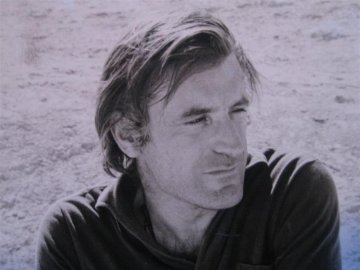
ted-hughes

Renowned Poet and Author Ted Hughes

The author from the third page onward goes onto to discuss in length the importance for him of Ted Hughes. He sees Hughes as a visionary – someone  who managed to tap into the spirit world and drag back important messages and visions, albeit leaving him a bloodied, harrowed and to a degree a broken figure, someone who has paid for the knowledge he has obtained. He goes on to relate this as a shamanic gift and curse, explaining to us how the process is necessarily painful in many aspects, to really be able to channel anything and relay an esoteric message.

In this chapter he uses many examples of animals, which Hughes used in his work, and how he relates these to totems, messengers from nature that Ted Hughes has given voice to whilst maintaining their animalistic, unashamed and of  pure natures. One particular part stands out for me here, where the author describes the use of the fox, an animal present in many of Hughes works, to point out the impact of his poems and delivers a powerful visceral image. This message is simple and clear – pure, raw oracular message that doesn’t lend itself to dissection without severing it from relevancy. This I think is demonstrated well from the following quotes from the chapter, the former from the author, the second from Hughes himself.

‘Hughes ceases studying literature after a visitation by a burned and bloody human-handed fox that delivers the pronouncement, Stop this, you are killing us. This theriograph is a magical messenger, not some prim angel made out of too many books, but a nature spirit. Poetry is not to be dissected to death, and neither is magic, nor, for that matter, sex.’

‘Imagine what you are writing about. See it and live it. Do not think it up laboriously as if you were working out mental arithmetic. Just look at it, touch it, smell it, listen to it, turn yourself into it’

As someone who has only read some of Hughes works, and was only partially exposed to the others, I still found this chapter highly effective in discussing how important mythos, and direct experience brought to life through pure unfiltered language is over an approach that through careless over intellectual analysis, orthodoxy, desensitisation, and deconstruction sees such messages stripped, diluted, and robbed of much of their meaning.

In some ways this can be seen as a continuation of The Cup, The Cross, and The Cave chapter for me, with poetry being espoused to be the purest voice we can give to relate these deep, and meaningful experiences. I found that even with my limited knowledge in the area, this was a powerful and important chapter that gave voice to some ideas that i was struggling to express.
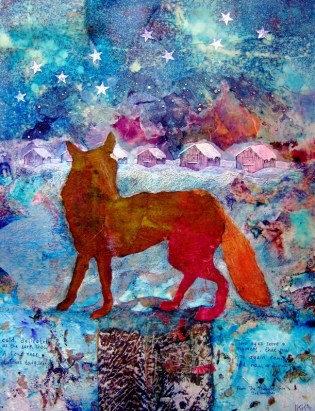
TheThoughtFox

The Thought Fox by Ingrid-Karlsson-Kemp

The Scaffold of Lightning

This chapter deals with the Horned God, the Devil, and how and why he has remained a powerful figure and is important to modern witchcraft.  It begins with a small definition, ‘the Devil reveals a narrow path out into a dark wood.’ before continuing onward, ‘Nor does it matter that at times he seems the Lord of the World, at others a more intimate local spirit. It is what he shows us that counts’.

From here, the author talks about the absolute power of the devil, that no intercessor is needed between witch and spirit. Through this, he demonstrates the power of Lucifer to show to the would be witch the path into the mysteries. It goes on to say that it is time that modern witchcraft as a whole paid the devil his due, and not to entirely white wash him of his antinomian aspects in the process.

The author then goes onto discuss the traditional medieval image of the devil as a demonic aristocrat, the last resort of the desperate who have turned away from the church, choosing a different master. He goes onto reminding us that this is a reflection through a society dominated by feudalism, and psychological warfare.

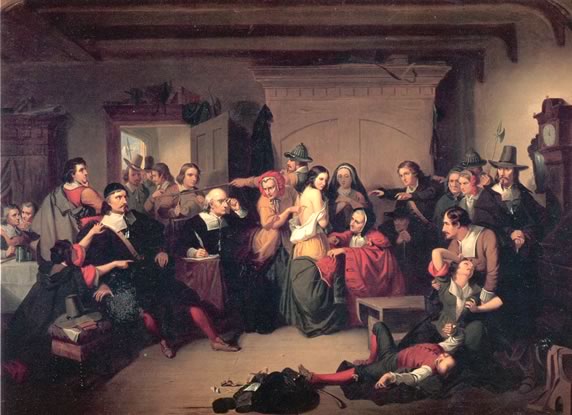
‘What we must remember  is that the accounts we have, almost always trial testimony, are performed as a penitential theatre of accused, judiciary, nobility, and clergy. Such a court is convened on a field of folklore, myth, legend, invention, and dream drawn out through torture, threat and false hopes’

However rather than simply say thus the devil is baseless due to the above, the author goes on to cite the following quote from Emma Wilby on The Visions of Isobel Gowdie.

‘Increasing interest in the folkloric dimension of witchcraft beliefs is leading scholars to consider that confession-depiction of the Devil might be rooted in genuinely popular ideas about embodied folk spirits, such as fairies and the dead’

He comments on this with the following:

‘Note the deliberate use of the word embodied. This is dynamite. It gives the Devil an existence that is recorded, experienced, and blooded in the folk and land’
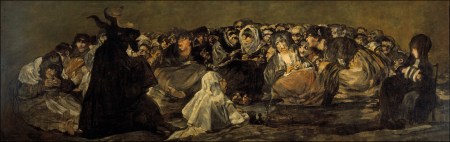
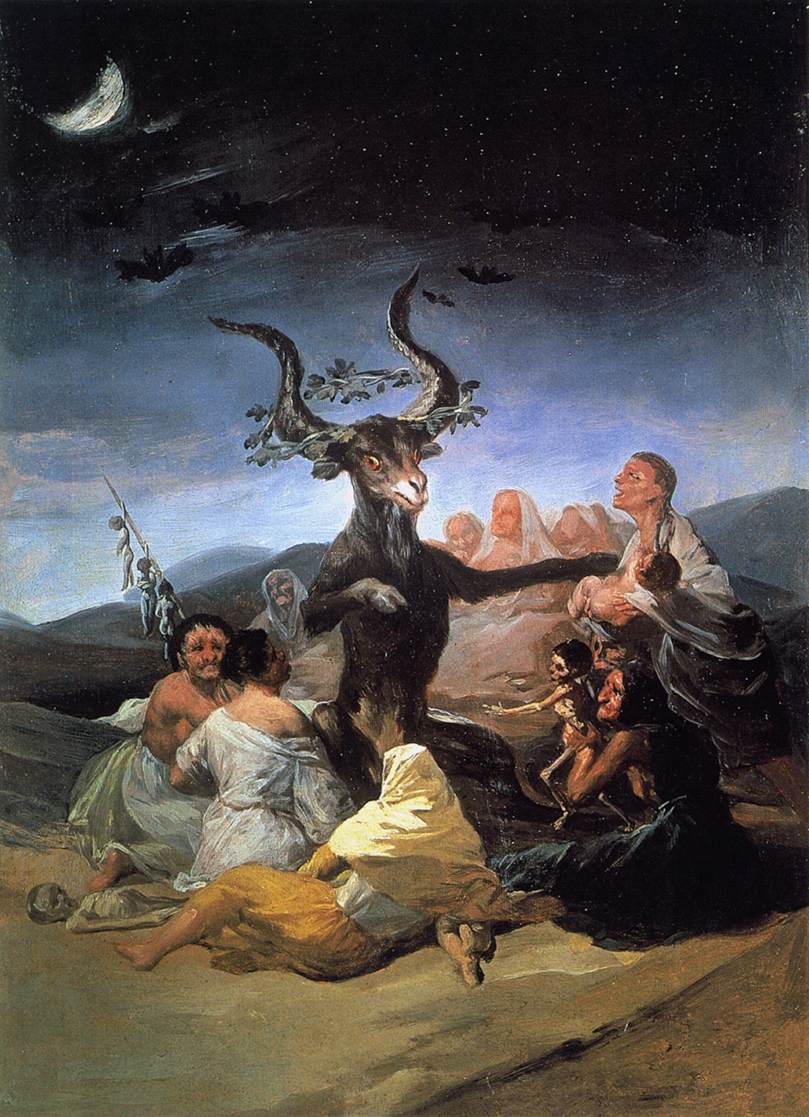
great_he-goat

The Great He-Goat by Franciso Goya

He goes on to say that that thus the devil is an aggregate, with the original folklore merging with the christian concepts and that they are bound together.

He says that witchcraft therefore must understand the contributions of European demonology and such magickal traditions, and not reject the fertile growth of new strains of Diabolism. He remarks that witchcraft should learn from the modern satanic ‘movement’ that has arisen and been drawn through popular culture, and understand the impulses that drive them whilst avoiding the dualistic trap that can easily occur within such belief systems.

‘The mistake made is often inversion, a potent formula of witchcraft in itself, but one that after breaking the social bonds often simply reforges them and chains its adherents to a dualistic script’

From this the author goes on to describe how the Devil is protean and changes as we change, taking on different masks. He argues that we cannot simply leave him behind to engage with a horned god of our forebears so easily, arguing that the masks of the Gods of the past came form the soil and social conditions, and that ours must also come from our own age.

From here he goes on to relate how the story of the God of Witchcraft is related through the story of the Devil, just as the hatred of women within Revelation tells the story of the Goddess unwittingly through Johns twisted psychology. He goes on to explain that ‘The Devil is a particularly European trickster myth’.  The author paints a scene of how the Devil was created in his current from through Christianity replacing Paganism throughout Europe.
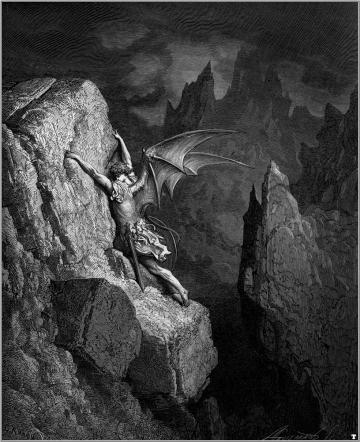
Gustave-Dore-Paradise-Lost-The-Fall-of-Lucifer

The Fall of Lucifer by Gustave Doré 

As he develops this, he goes on to state how this image is now useful to the craft in the described age of human disenchantment and apocalypse as described in the previous chapters.

‘It is at these crossroads, translocated from lost Jerusalem and before that Babylon, that the division between high and low magic, heretic and mystic, magus and necromancer,  magician and witch. Our identities merge and are lost in the dance that we can now properly call the witch cult. Who could preside over such a gathering other than the motley Devil?’

After covering these points, the author goes on to ask us a deep question.

‘Who then is this Devil? A simple answer will not suffice, the answer is complex, personal, and the resolution of polarity..’

In light of my own posts on this issue to clear up my own approach and answer to this question, wherein i describe the Devil as simply a powerful face of the antimonian aspect of the Horned God focused and concentrated through Christianisation , i found this a highly interesting read and accurate from my own perspective.

The Children That Are Hidden Away

With the Devil addressed, the author then uses this subsequent chapter to deal with the Sabbat. This chapter is powerful, and outside of The Cup, The Cross, and the Cave my favourite chapter, due mainly, admittedly, to my own biases towards and interest in Necromancy.

The opening paragraph sets up the chapter fittingly:

‘The Sabbat is the love feast of the Witchcraft. It is the central rite by which we have been both identified and condemned. Our revels have been daubed in the blackest garb…. This list of atrocities is why many modern proponents of witchcraft have been quick to distance themselves from what has been considered a demonological imposition upon a simple folk faith’

He then brings up Carlo Ginzburgs work, which he believes by attempting to clean the Sabbat, similar to the attempted ‘cleaning’ of the Devil in the previous chapter, is misguided. He argues that rooted in the Sabbat, in all its aspects, is a deeper truth that can be explored and revealed. He argues, in his own words, that his ‘thesis is that the Sabbat is the survival of Mystery cults and a resurrection mythology which is concealed in the Great Rite itself, the mystery within the Mystery… I want us to celebrate the Sabbat again, not by standing unsteadily on a stack of books, but on the Sabbat mountain itself’.

Thus he begins his exploration. First he describes the Sabbat in broad terms, stating that ‘the Sabbat is far more egalitarian… it strips away difference. It summons us. This calling is the inner aspect that defines a witch, rather than the outer social aspect of the accusatory pointed finger of condemnation. The first flight to the Sabbat is very often a spontaneous event. One which is not mediated by  coven or ritual. It is a lucid, though often shocking, transfiguration’.

From here he begins to talk about how the Sabbat experience, through such figures as Johannes Wier and Reginal Scot became associated with delusions, and that in an increasingly materialistic world, the experience has been devalued, and is instead seen in the terms of a solipsistic, neurotic experience. The authors reponse is to reject this, and he goes on to say that it is this zone, the Sabbat experience, which must be again placed as the core practice within the craft. He cautions again that to remove the ‘forbidden’ aspects is to excise it of much of its meaning.

He then moves onto discussing entheogenic drugs – the salves and flying ointments that were often applied to induce such experiences within the witch. He goes on to explain that although indeed such salves were used, this does not discount or cover all the cases of Sabbat flight.  He specifically addresses the processes of the salves application as more than simply the reaction to polypeptides, and notes that they are also poisons, able to take us to the state that exists between life and death. He goes on to speak about this shamanic liminal state, which can be brought about by many techniques and circumstances such as fasting, and ritual practices.

He ends this section of the chapter decisively with the following:

‘My considered position on whether the Sabbat is physical or not is that the question itself is absurd. Witches do not divide the states of sleep and dream and vision. This magical monism is something rare in literate and modern minds… It is a shamanic conception that must be embodied in our witchcraft.. if it is to both have and provide meaning’.

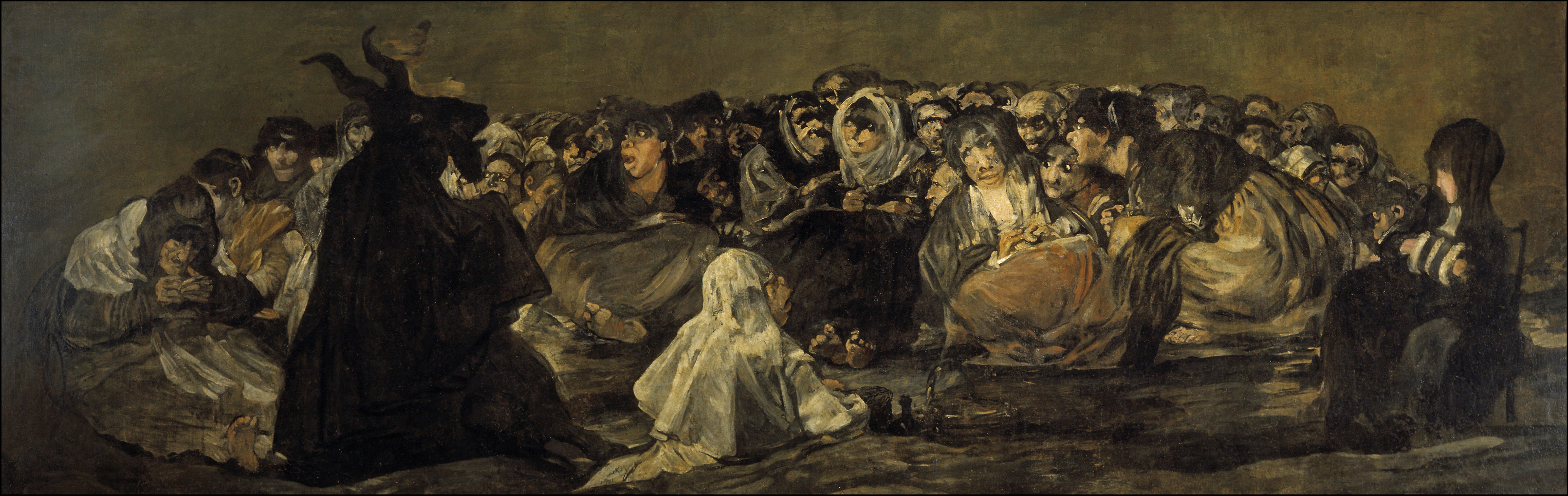
Francisco_de_Goya_y_Lucientes_-_Witches'_Sabbath_-_WGA10007

The Witches Sabbat by Francisco Goya

From this point onward, he begins to talk about the nocturnal associations of the Sabbat with the dead, and how the witch becomes one of them during flight, assuming the forms of ‘our [the practioners] dead, our blood, our totem’. It is through the ingredients of ash, blood, milk and dew heavy moon he argues, aligned with the necromantic and lunar aspects of the feminine this transformation is most facilitated, and goes on to ascribe timing as being critical, fixing the time most ideal for the Sabbat at the full moon. He goes on in this manner to describe the Sabbat as far older than a bastardisation of the Jewish Sabbath through Christian propaganda, instead tracing it back to its Babylonian origins from the Akkadian word Sapattu or Sabattu. It is here that the author mentions for the first time the number 15, relating it to Inanna’s descent to the underworld and other points of significance that he will go on to elaborate on in a later chapter.

He then with this said moves onto describing the sacred mountain of the Sabbat:

‘We are journeying in our transformed bodies to a singular destination, the sacred mountain. This is the vision of the Grand Sabbat. The participants come from the flung compass points, there is no uniformity, but quite the opposite, all heresies are on the wing’.

He ascribes the name kur to this mountain, where the Sabbat takes place a word the Mesopotamians used to describe it, a place that is at the same time both peak, and underworld. Here he begins the comparison in earnest, drawing comparisons between the medieval Sabattic images and Enkidu’s account of the underworld from the Epic of Gilgamesh. He draws further necromantic comparisons between the hollow kur and the skull, and how both represent an external and internal transformative process

Lastly, but not least, the author asks the question to what end is the Sabbat partook in? He then  answers it by describing what happens at the Sabbat, which in itself reveals the answer. The author selects themes common to all the tales of the Sabbat, such as dismemberment, feasting, dancing and sex. He goes deep into each of these specific sections, revealing aspects to why they are important, what they represent, with themes of ecstasy, birth and death, and the dead all combining to show quite effectively the importance and direction of the Sabbat. That is, its role as the great rite, where in mixing of these elements arises the cycle of life, a divine resurrection, where upon the living dance the dance and the dead are reborn into the world.

Gheyn_Sabbat

Sabbat et cuisine de sorcière by Jacques de Gheyn

This section is powerful and difficult to cut down into a more concise form, so I’ll leave it to the reader to explore this part of the chapter in more depth.  It successfully delivers however, I believe, the powerful intention the author is trying to make, and is definitely something that resonated with me.

A Wolf Sent Forth to Snatch Away a Lamb

With the subject of the dead, and the devil, covered, the author goes on to the topic of Animal Transformation, primarily through tales and talk of the wolf and of lycanthropy. Whilst many of the chapters are based on the female, lunar, dominating current on Witchcraft, this chapter deals with the more male aspects, of which the author brings an interesting perspective.

The chapter starts with several paragraphs laying bear, in poetic terms, the hunger of raw need for man to be ‘rewilded’, and the reader brought into the imagery of the human as animal. He then raises and answers effectively a none too basic question, which is where men fit into his mythic topology of Witchcraft, which the author himself as being, due to the Lunar links, primarily a womans affair. He answers it thus:

‘.. the answer has already been given in the song of the wolf. Men are excluded from many of the rites of witchcraft. Men do not. Thus our mysteries differ from those of women.’

He then goes on to describe the early accounts of Lycanthropy involving male witches. However, to delve deeper, he first cautions we must be careful with this train of thought, reminding us that women have also assumed wolf form in the past, and that the ‘wolf has too often been rune-hooked into a totem that the wolf itself would not recognise’. He cautions us at accepting the wolf, as the icon it has become, due to it often being seen as a left handed path image of domination that suppresses the supposed weaker, emotional feminine self.

He goes on to describe this wolf image, describing it as socially broken, the images it projects of abduction, murder, and rape not describing accurately, nor capturing the essence of the wolf. He describes such a lone wolf as sick, and makes a parallel with the witch at the pointed finger , describing the wolf as a male representation of the same ‘blame’ game.

He goes on to describe the totemic wolf as he sees it, animals that taught us how to hunt, ambush and lure, ‘mighty hunters who sing to their mother moon’. Here he also highlights the social structure necessary in the wolf, highlighting parallels between us.

He again brings up the theme of being rewilded in this context, and describes how many items from wolves were meant to have many magical  powers. He describes how even now this lycanthropy occurs in dream and dance, and points it out as the image of the Northern winter sun, the downed stag representing the summer king subdued and dominated. Again he makes the comparison.

‘The men who go forth as wolves are the retinue of the divine huntress, a reckoning at large in the land, a stormy night that beckons to the bold whilst the dogs lie sleeping in their beds.’

It is here he begins  displaying them as ghosts and teachers, linking them to the ancestral dead, our familiars, as warriors, transformed witches, and agency of the Goddess. He links the hunt to nocturnal vengeance, sexual voracity, ritual actions, animal transformation to blend in and sending forth the fetch, all occurring under the full moon. As he describes it, this Sabbat like imagery ‘is the same familiar unfamiliar territory’. That is, the territory of truths preserved, just as the Sabbat was, with a malevolent face.

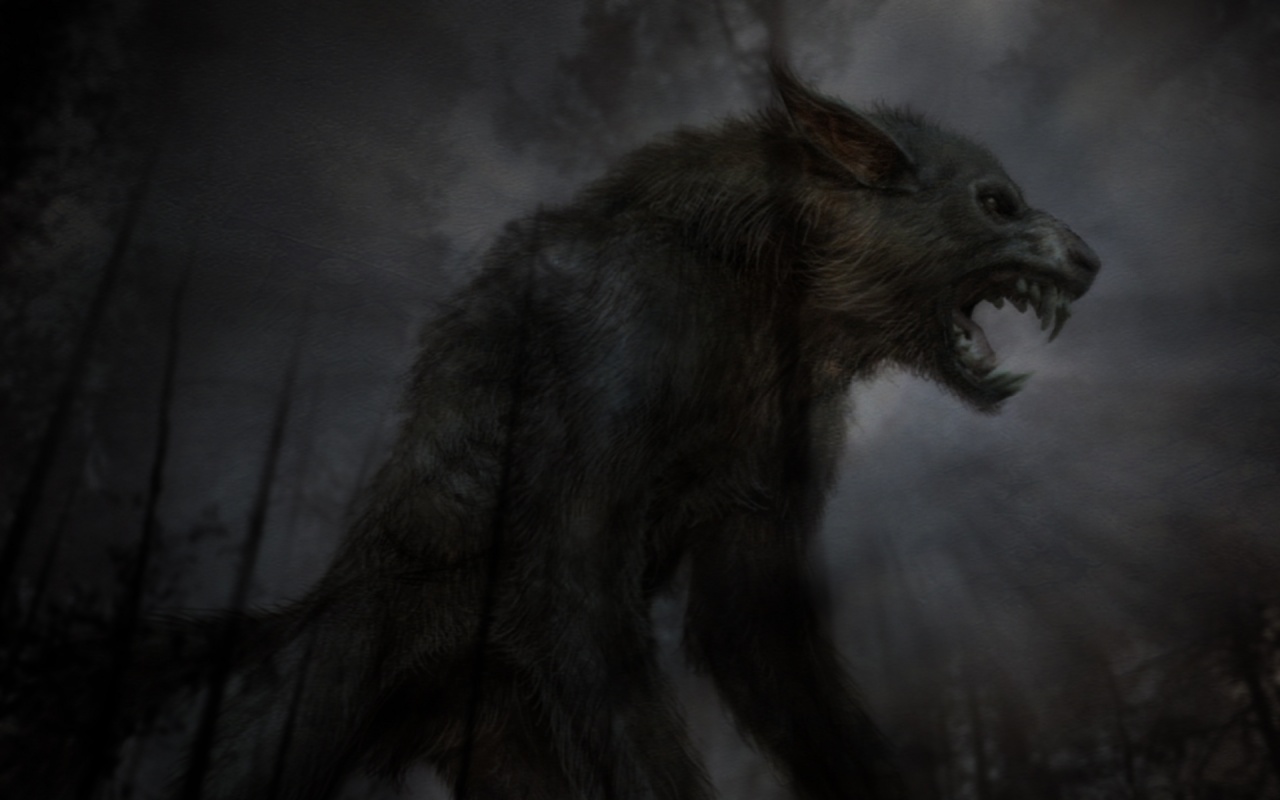
lycanthropy1

Werewolf, artist unknown

It is here he delves into the associations the wolf has had with the warrior cults of northern and central Europe, and how wolf skins were seen as sacred, and used as amulets. He again sees how this was usurped, and turned into the raw, diabolic imagery described above as it was subsumed into association with diabolism by the church. Here, retaining its essential nature, but becoming  another ‘part of the sorceress conspiracy’.

He goes in to describing how this is similar to the bear cults also found in Europe, and the use of drugs such as muscaria to help drive a divine possession and frenzy within its adherents. It is here he reveals his purpose, describing war as a special kind of hunt, the male parallel to female blood shedding. He goes into this in great detail, and again, its not something I can appropriately summarise in a short manner. One quote however, I feels explains some of the authors intent.

‘The man or woman who becomes a wolf is engaged in a cyclical transformation that takes them outside of culture. For women this a given, they are periodic, but for men this requires ritual action. The WItchcraft of men is thus built and dependent upon the blood of women. Blood must also flow for men to be initiated. Whipping, sub-incision, scarification and tattooing are among the ritual actions that can be performed. This does not imply simple masochism’

It is from this image he moves into discussing truly the ‘resocialised wolf’, using it as a metaphor for the reintegration of wild aspects back into our own natures. He goes on to describe  this process in degrees. First he tackles the wolf image, again using metaphor. In this, he states that what we need aren’t lone wolves, but instead socialised, integrated wolf packs, packs that are loyal to the Goddess. He regards this as part of the inversion of the wolf’s image, no longer an image of dominance, male dominance and female suppression, but  an elevation and joint synergy between both. On this he writes:

‘What if we become wolves in her service? I suggest that Witchcraft represents such an inversion,  a reversion of the patterns of abuse and domination that … have divided the sexes in setting men upon women’

From here he goes on to describe the kind of animal transformation he sees, based on this inverted pattern. In this section he engages us to think about re embracing our physical natures, embracing our physical bodies. He warns us that we are in danger of ridding ourselves of our bodies like ‘cartridge cases’, and goes on to detail the sacredness of ecstatic and excited states. He explains that these have been under assault in common thinking, especially in some circles which overly  embrace eastern mysticism which discards this in bodily rejection. He again comes back to the entheogens, but this time talks about the sacred stimulants, as opposed to those used for night flight, again reminding us to not make an artificial distinction between either. It is through both body and spirit, he argues, that these states are accessed, and the interaction achieved.
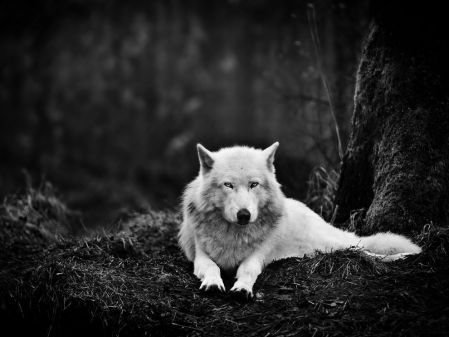
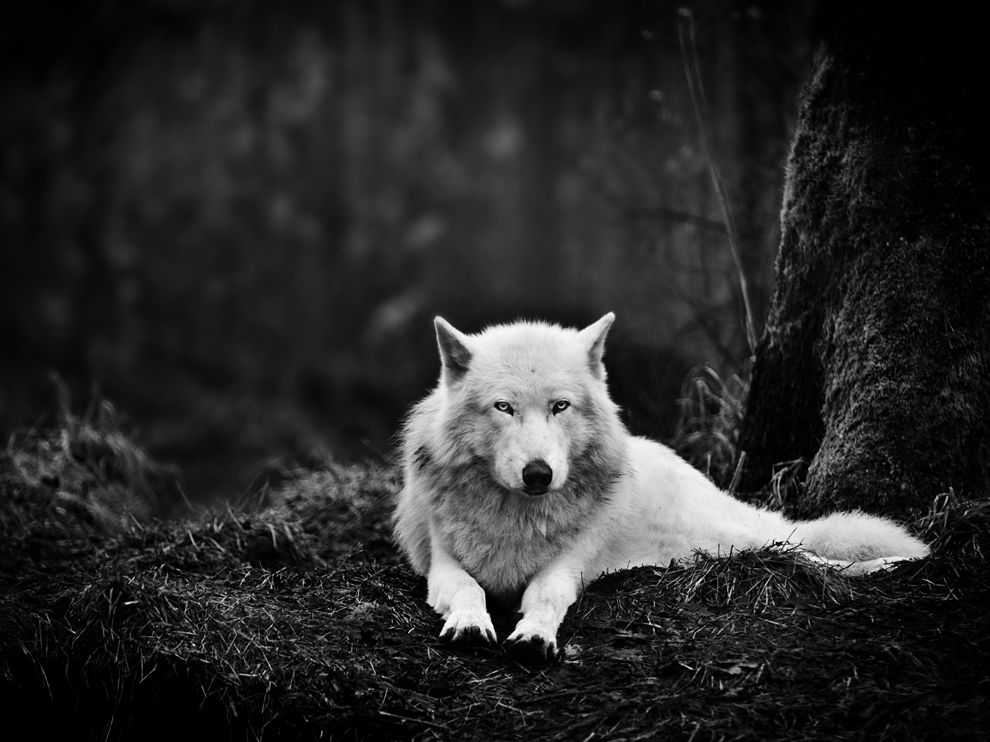
gray-wolf-sanctuary

Gray Wolf by National Geographic

It is from here he goes on to relate about Lupercalia, and goes on to discuss the mighty dead and the Wild Hunt. He relates how the wild hunt fits into the topography, not as a simple new moon event or full moon event, but instead a complex mix of both, of both the Sabbat and Bloody Moon. He then goes on to seal this wolf tale as the final piece, that completes both halves of the mythic structure he has been constructing. He gives us an collected, summarized version of this in the text, which i think is very revealing. The last part of the text drives home why this is important in our age to understand the metaphor and image of the Wolf and our spiritual Ancestors, leaving us a great image with the end of a revealing chapter.

‘The wolf [is now] the shadow of man. We have hunted the same prey. But we have fallen out with these brothers and sisters, to our detriment and their extinction. Let us decide to play the game again. Let us turn over the cards of Dame Fortune. XVII La Lune reveals even dogs are transformed on certain nights into their ancestors, and that it is blood which provides the key. Through this slim fence slip once more the gaunt wolves into the city, our throats erupting into song.’

Fifteen

In this chapter the author begins to discuss the Goddess, leaving perhaps the topic to later in the text than we might have expected. It is here we see the revealing of many symbols of the Goddess, of the authors own personal mythological topography, which has slowly been threaded through the work.

The chapter opens up with poetic imagery of the Devil as Initiator, who has brought us to meet with the Goddess in the dark wood, stripped down to nothing but our skins. From here, he goes on to describe the cyclical life of the moon with similar imagery, referring it to the cycle of life, and the circle that connects all things. He then relates to us that the Goddess being seen as the moon is a mistake, and that instead that ‘She is Time Herself’.

He goes on to relate how its Time that encapsulates all the moon phases, the aspects, with the Sabbat marking the ‘moment of Immanence’ within the ‘cycle of flux and flow’.

From here, he goes on to explaining this in greater detail, and reveals that the Goddess is never named, only referred to in oblique terms.  These terms being ‘ciphers, blinds, riddles, points of origin’ and other aspects. He then goes on to describe the most enduring one, that of Fifteen, and describes it as important as the easiest way to envision her outside of cultural forms that can compete and clash. From here he goes onto describing the symbology behind and the integration of the lunar calender, revealing the number 15 and 13. These numbers, he relates, arise from the number of the day the moon falls on in each lunation and the number of lunations in each full year respectively. He goes on to relate to us how this is integrated with our environment and ourselves.

‘For the lunar calendar to exist required it to have embodied meaning, one which meshed into a series of species and events, of salmon runs and rutting deer and moulting bison and sleeping and waking bears. It is a cycle of seasons over which a Mistress of the Beasts prevailed. For us to engage with the mythic, we must be attuned to its many pulses over which the moon rules. But crisis intervenes.’ 

He relates how when the human race moved from being a purely hunter gatherer race to a one based around agriculture, this calender necessarily followed, along with the associated underlying mythic architecture.

‘Now it was not simply the salmon run, the story of the first flowers in the meadow, but a million tributary rivers carrying us on. Her sex runs wet … And so our Goddess slips from the reed banks and finds herself within a second cave at the temple heights’

It is here he carefully and considerately makes the connection with Ishtar, and delves deep into the symbology and meaning which embodies the number 15, the sacred marriage between the sun and moon the comes to its height on the full moon, and the day which Ishtar began her descent into the underworld.

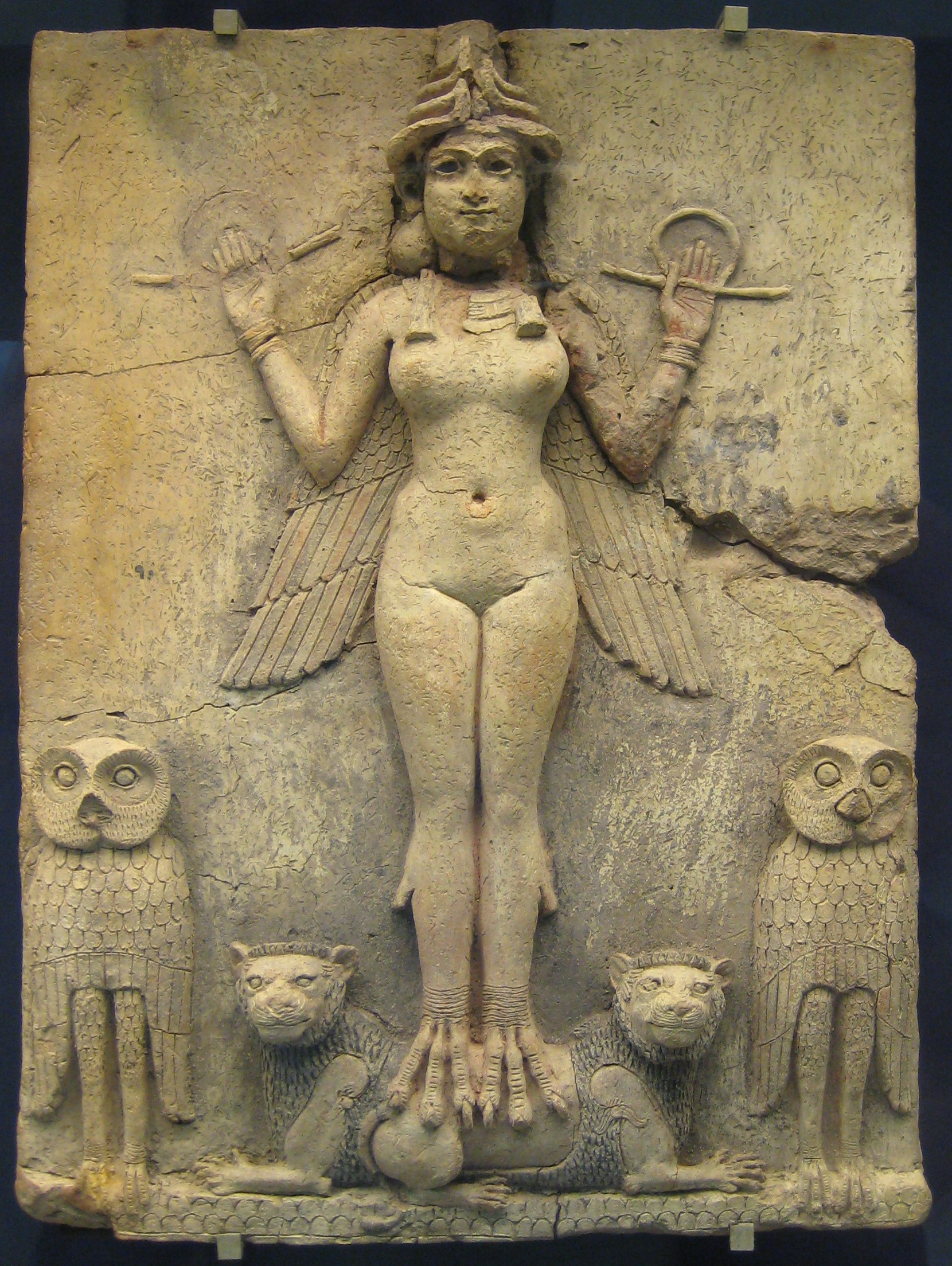
British_Museum_Queen_of_the_Night

Queen of Night Relief, The British Museum

He goes on to describe Inanna-Ishtar as ‘the primal spring’ of the origin of the Goddess of Witchcraft, He goes on to directly link her to many other concepts of the Goddess. He explicitly singles out the greek goddess Hecate being another face of Ishtar, and highlights other figures such as Medea, Circe and Artemis as arising from out of significant Akkadian cultural influence.

He goes on to say how Ishtar has been  misidentified not only in ancient but also in modern circles. He gives an example of this in the fact the Queen of Night Relief is commonly linked with Lilith, herself ironically arising from the Akkadian concepts of the Līlīṯu, a class of  female demons.

He goes on to relate how although this could be a useful aspect, that it narrows the scope of the Goddess into simply a malevolent force, when she is infact a master of all directions. He associates the Lilith myth and angle as therefore being potentially constricting.

Again, he goes on to talk about the dark moon,  how it runs with blood and how it should not only be seen as a curse but a gift, and reinforces the importance of 15 as the centre of the cycle and the axis mundi where the aspects meet.  He discusses Kali as a overpowering face of the rotting goddess, warns us of appropriating her own rites and asks us to turn inward to find our own, western analogues. He describes this thus:

‘As our focus has been on the central rite of European witchcraft, namely the Sabbat, this has been occluded. Perhaps the best way to signal its importance and very nature is in this absence and deliberate omission. It is the shadow beneath the wings of this text, but enfolded as a blood seed at the heart of the Sabbat.’

This flows into the paragraphs describing the immense disruptive power of the eclipse. In the final paragraphs, he describes and gives voice to what he sees as the overriding presence of the Goddess and sums it up in the following manner.

‘She is not external. but is enfleshed … There was never one goddess of witchcraft, but rather a thousand Ishtars: milk white, blood red, lamp black. There can never be orthodoxy. We are simultaneously possessed, annihilated, and forever outside of Time. 

She is Immanent.

She dwells within us.’

V0045118 Kali trampling Shiva. Chromolithograph by R. Varma.

Kali by Raja Ravi Varma

Hic Rhodus, Hic Salta!

The last chapter in the book, Hic Rhodus, Hic Salta, is an effective ending which manages to, in my opinion, sum up the main messages in the book in a clear and concise manner. The epigram used to name the chapter is described at the end, but to make the summary of this final chapter more approachable, ill detail it here.

The phrase Hic Rhodus, hic salta, originates from the Latin version of Aesops Fables. Literally translated from the early ancient Greek phrase, it means ‘Here is Rhodes, jump here!’. It relates to one of the fables, where an athlete boasts that he once achieved a seemingly impossibly large jump whilst competing at Rhodes. A bystander challenges him to dispense with the accounts, and simply prove himself by demonstrating the jump right there, on the spot. Thus the term came to be a proverb, meaning ‘Prove what you can do, here and now.’

As hinted at by the book, this is the conclusion that this chapter, and that the book reaches. The author gives another version of the phrase as the final words of the book, ending it all on a simple but powerful note. Within this chapter this message resonates. It  is not presenting to us a request, or even offering advice, but a challenge. To meet this challenge, the author suggests that modern witchcraft needs to concentrate on imbuing itself with  Orientation, Presence and Imperative.

A Single Red Rose

He goes into detailing these length. I will cover these briefly.

He describes Orientation as embracing animism and finding a shared mythic topology on which to find common ground as Witches.  He believes that through the words of the poets, and through the Sabbat, Night Flight and Animal Transformation this has been found, and through the revealing of the Goddess and Devil revealed as One. He describes this as being a ‘simple and not prescriptive’ topology, which acts as a way for the witch to connect to the world through their own, internal interface. From this, he states that the doors are opened within and without, as we develop on top of this our own means of interacting with the world in a way that is based on connection as we interact with All, rather than fall into some baseless solipsistic reverie.

He then goes on to describe Presence. He begins this section by saying that we must not make the mistake of believing ourselves to be apart from the physical world, and make a fatal mistake between the physical and spiritual. He reminds us that animism sees no such divide, and therefore does not strip meaning from the physical world to abstract it away. Its through this integration, and through the paradox of travelling in and through our our bodies at night we can reach the Sabbat through the gates of dream. As such he asks us to re-sanctify it, strengthen it, and grow active again, so we can move renewed. He gives us a taste of why presence is important within the following paragraph.

‘The mythic is not an overlay, it is the worn cupolas in the rock quoits stacked in the barren moors. It is the black earth of the barrows. The earth is pregnant with meaning, with tumuli and foreboding entrances slanting down into the underworld which we have crawled from on skinned knees into solstice morning dawns. This is magic, this is what demands our presence, and furthermore this is what is at stake’

The final aspect covered is Imperative. The author uses the last two to reinforce this aspect effectively. He goes on to relate how we cannot escape into solipsism now even if we wanted to, and instead are demanded, forced, to take an active stance. He says that we are defined by not contemplation but engagement. The imperative leads to this engagement on its own, due to the fact that true witchcraft is grown from need, not want, and that in our current time it is needed more than ever. He shows us that since our shared experience is based on animism, we must defend a world that is increasingly trampled, and the imperative is in that struggle. The struggle that if it is lot,  our familiars, our family, will be irreparably injured or killed.

On this powerful call to action, and bringing the entire thesis to a powerful conclusion, this chapter concludes thus.

‘Here is the Rose,

Dance here.’

Conclusion

Writing this review has been long and difficult. However, I felt it was more than necessary after receiving, and reading this book. That is the highest compliment I can give it – that it exceeded my expectations, and was a captivating read which seemed to give a voice to many things that already resonated within myself.

The author describes the book as a revolutionary book, as a challenging one that many have found issue with. To me this is almost difficult to imagine, as it seemingly simply described what I have been consciously and unconsciously feeling ever since my own initial encounter and introduction to Witchcraft and Paganism in general.

I honestly think that it is an important work, and that it should be acquired by anyone who calls themselves a witch or is interested in modern witchcraft. It is a highly inclusive, revealing and passionate work that I think will only be increasingly referenced and appreciated as time goes on.

I’d also like to thank Scarlet Imprint for linking to my review, and enjoying it. It means a lot to think that my own personal take would be read and warmly received by them. I look forward to receiving more of their books in the future, if they are of similar quality (of which I have very little concern over).

As far as the blog is concerned, this will most likely be the last long post in awhile, due to my personal circumstances changing (for the better) leaving me with a lot less free time. I’ll be detailing this in a another, short post, that should hopefully come soon.

Thanks for reading as always.

~S~

Review and Summary: Apocalyptic Witchcraft – Part One

Posted in Occultism, Paganism, Traditional Witchcraft with tags , , , , , , , on September 19, 2013 by Sypheara

Introduction

So at last I finally have managed to get  around to working on and completing this entry. This is going to be a large one, revolving around a new work released through Scarlet Imprint, known as Apocalyptic Witchcraft. Written by Peter Grey, I believe that this book is another important milestone within the world of Occult Publishing and Witchcraft in general. For those who are already on the fence and have some inkling as to what this book relates to, my whole recommendation and this post can be summarised quickly and simply: it’s an important work, if you are the least bit interested, order a copy at the next available opportunity. For those who have yet to be introduced to this work, and know very little about Scarlet Imprint, hopefully this will be an informative post.

The Publisher and Build / Aesthetic Quality

Founded in 2007, Scarlet Imprint was originally created in order for Peter Grey to self publish his work, The Red Goddess. Since then, alongside several other Occult publishers, Scarlet Imprint has gone on to contribute massively to the growth of the Occult publishing scene releasing many works by a diverse range of authors. These works cover a large section of differing paths, and alongside Ixaxaar, has become for me one of my primary sources for new texts.

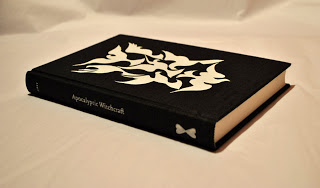
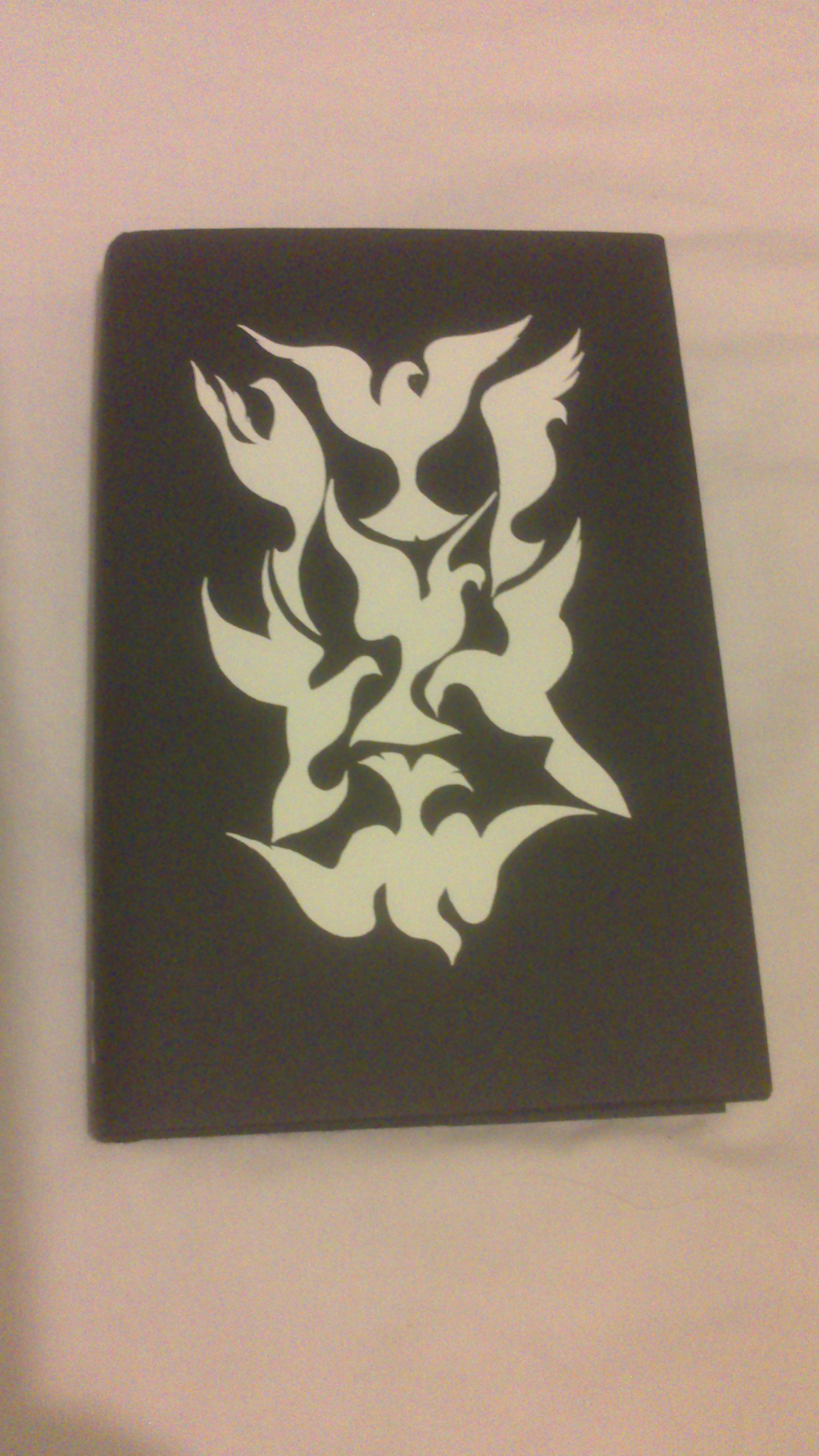
Upon seeing that Peter Grey was releasing a new book authored entirely by himself, and having not had the pleasure of yet reading The Red Goddess, I made it a mission of my mine to acquire a copy of Apocalyptic Witchcraft.  The edition I went for was the standard hardback edition – my usual compromise between quality and cost when it comes to purchasing Occult books.  Called the Of The Doves edition, this book as described on the site,  is an octavo book of 200pp, that has been bound in rough black linen cloth. A picture of both the side version and my own can be seen below.

a7ed8-apocalyptic_witchcraft_lg

Picture from the Scarlet Imprint Website showing the Of The Doves edition.

From first glance, the book looks very striking both inside and outside of its dust jacket. As the website states, the Doves are a symbol that is highly important within the work itself and the meaning of them is brought forward in the text. Although not in the same league as the talismanic and consecrated magical books I own, it does seem to still to exude a power of its own that really does invite it to be read, and understood. As with all other Scarlet Imprint books I own, I can therefore say it appears to me to be of high quality in its construction. The paper used feels thick and good quality, and appears to be well bound as well.  It feels weighty, and robust, and like it could survive in my often perused collection for quite some time.

Several images of the exterior and interior follow. Unfortunately, all I have got to really take images is my phone camera, and the results vary widely. I have trouble getting it to focus sometimes even with setting changes. Hopefully these will be sufficient to illustrate the above point.

DSC_0206

Exterior shot of book in it’s dust cover.

DSC_0219

Shot of the interior of the book, displaying the title page and the end papers.

DSC_0214

A shot showing the rear and spine of the book.

With the pictures of the exterior and interior out the way, I wish to move onto the contents of the book itself. Here I intend to summarise each section and also add what I took from each part of the book.

Exordium

Firstly, the book opens with a small prefacing chapter called Exordium. An Exordium is a a beginning or introductory part, especially of a speech or treatise, designed to put the reader in a favourable state of mind before reading the main text. The Exordium in Apocalyptic Witchcraft does this excellently, and summarising it here will I think give the reader a good overall impression of its content and what the author is trying to cover/convey.

DSC_0212

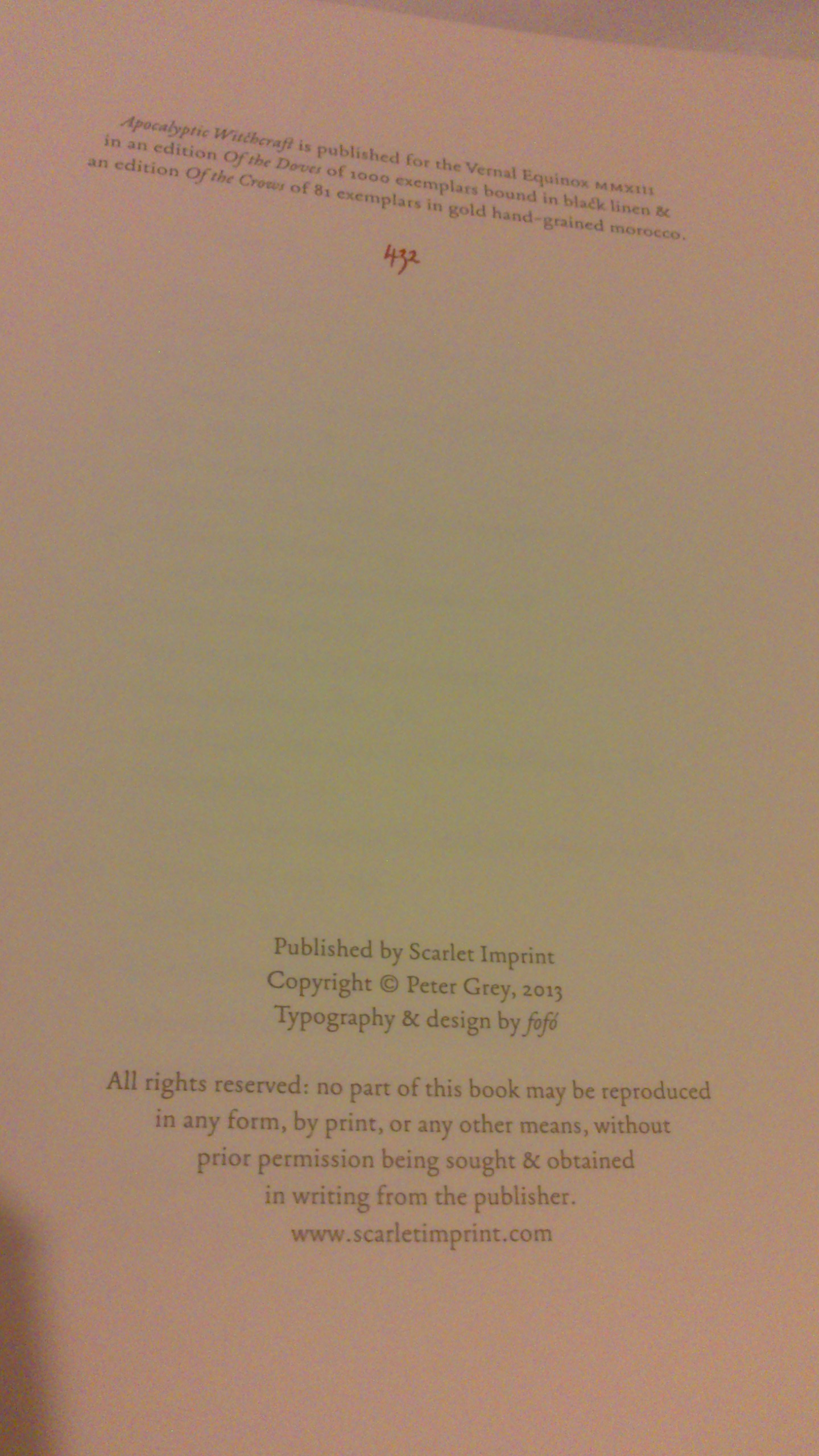
Interior shot showing the hand numbering of my copy.

The Exordium opens with a clear statement declaring the books radical approach. From its own pages, it loudly declares that it ‘is a book which dares to prophesy’ and that it ‘is a perilous book, and one which does not aim to please’. It also states that its goal is to presents a view on ‘witchcraft for those who know that the wheel of the year has broken from the spokes of the seasons’. The Exordium tempers this stark opening two paragraphs with the following, ‘It does not ask for belief, adherence or followers. …. it simply asks that you listen’.

This section is followed up by a clear and precise mission statement. In the authors own words, ‘This is a naked proposition put before you; to read again meaning to all these things [witchcraft]. To ask, what is it that underlies the pattern of our magic? What is the essence of Witchcraft itself?’.

With the mission and feel of the book made aware to the reader, the author then goes on to describe the language the book will use to describe its concepts. ‘Neither is this an easy book, though the ideas are simply enough, and they need to be expression in the language of magic, as poetry ….. If i have taken liberties with ideas, then the mistakes are mine. If my writing is more ragged on the wing that writers who precede me, I answer that it can still fly. If this work is needful of more time, I confess it is a luxury none of us possess. My wish is that readers find new avenues of inspiration from these sources and enrich their practice with them. Time is of the essence now’.

The Exordium does a great job of introducing us to the topic the author wants to break open and display the guts of – that Witchcraft and Paganism must grow into something new and radical, with a renewed spirit, to become something that is highly relevent for the modern, apocalyptic age in which we live within. Peter Greys passion and use of imagery to bring a point home is illustrated in this section before we even get to the main text, and begin consuming the main body of his work.

DSC_0213

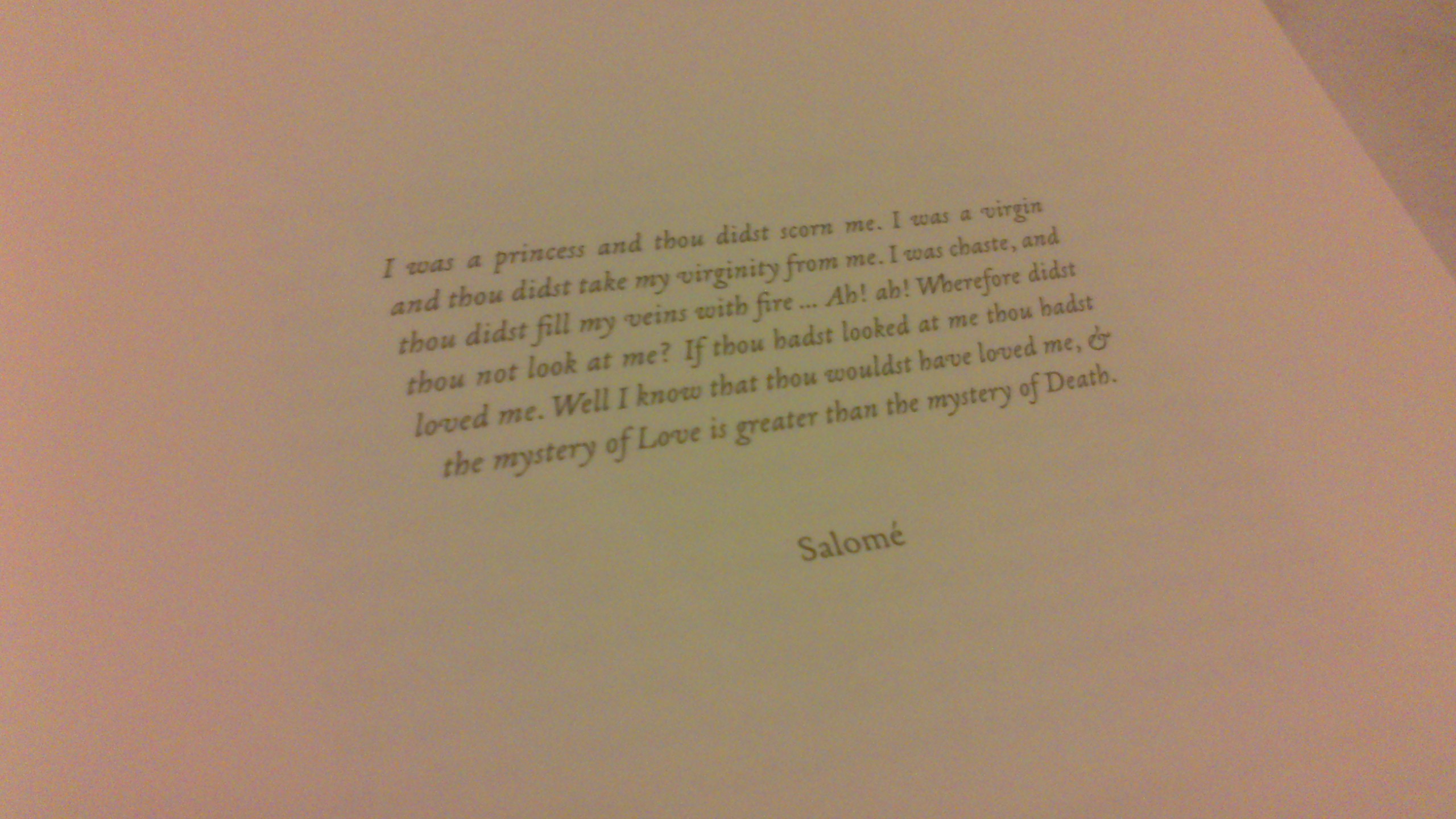
The entire book is written in a poetic like prose that helps to convey the meaning far better than dry text. Interspersed between the chapters, poems like these help reinforce each prose section and help one chapter blend well into the next.

Main Chapters

With the Exordium over with the book launches into the meat of the topics at hand in the following chapters. There are 10 chapters in total, each covering a specific topic. These build one from the other, and as the author states in the Exordium, are best followed in order to be fully understood.

Apocalyptic Witchcraft

A  Manifesto of Apocalyptic Witchcraft

She is Without

The Cup, The Cross, and the Cave

A Spell To Awaken England

The Scaffold of Lightning

The Children That Are Hidden Away

A Wolf Sent Forth to Snatch Away a Lamb

Fifteen

Hic Rhodus, Hic Salta!

With the chapters listed, I’ll now try and attempt to summarise them in a basic form along with comments.

Apocalyptic Witchcraft

In this opening chapter, the author launches into full flow. In this chapter, the groundwork foundations fo the entire book is lain. The author points out several important points in this chapter, that run throught he rest of the work. For example, he describes in poetic fashion the force of Babalon, and goes on to point out how Witchcraft is rooted in in the land, and the web of life. He goes onto further elaborate the reason for the books antagonistic tone – that he is opposed to how witchcraft is seen and used as an excuse to retreat into seclusion within the practioners own mind.

Following on from the beginning of the chapter, he asserts that witchcraft is rooted in the the world as it is, and as radical changes cascade through our world, our traditions must by necessity also change. He goes on to point out that in witchcraft and paganism is not only tradition, but by necessity innovation, becoming and necessary revolution.

From this, he argues that due to Witchcraft  being a tradition of renewal, coupled with the dying age in which we live, by necessity it must rise to confront the new challenges presented to it and take on new, renewed form. As the author says quite poetically, ‘ World’s end is not a threat from the pulpit, we have assembled it with dextrous and sinistrous fingers, bunkered our oblivion for the days of the final division of plunder now at hand. We will not follow the smoke to the stars until we are burned on the pyre of the earth. Love is the war to end all wars, and the war is upon us’.

This section really hammers this point home. That through breaking from nature, all humankind, including ourselves, are complicit in the conditions which assail our environment and the real physical world in modern times. This is an important point the author makes. Not only is it the big multinational corporations, corrupt governments, and greed driven cultures but also each individual that wittingly or unwittingly, has contributed to the problem.

From this position, the author goes on to define witchcraft how he sees it. He paints a unified, undiluted picture devoid of any attachment to a particular form, holding back from ascribing to his arguements any sense of orthodoxy. ‘You will find witchcraft at the end of a pointed finger…. To prettify witchcraft is as ill-judged as to disfigure it. You cannot deny the Goddess in any form of cast lantern light or play of shadows. You cannot say white witchcraft or black witchcraft without doing violence to Her complete being. It is time we heal this wound. Consider the words of the Thunder Perfect Mind: I am the Whore and the Holy One’.

He then asks the question as to why modern paganism  and witchcraft has thus far been insufficient to deal with the problems facing us and confront our enemies. He goes on to identify ‘modern’ paganism as witchcraft as beginning primarily as a compromise with the repeal of the witchcraft laws, and the careful experimentation that arose from this. He argues that current teachings that hold witchcraft to be practiced in a harmless or watered down fashion need forgetting, and instead a more proactive way forward should be sought. In his own words, ‘ I say that the power of the witch is in having every option open. Witchcraft will not lie beneath, will not be disarmed… Witchcraft, and by that I mean malefica, is the strong face we should show to this world. This is a merciless path…. [Example of the the solonaceae is given] enable us to fight poison with poison. There  is no way to separate the powers, and no way we should be cleaved from our rights to exercise either’.

He then goes on to caution however, against infighting within the Pagan and Witch community. He wants against horizontal hostility between people who fundamentally, hold similar values and belief systems no matter their mythic underpinning. He stresses this is additionally important in an age where a united witchcraft and paganism on some level will be necessary to survive, and that instead, Witchcraft and Pagansim should collective grow and adapt into a force for change and effectiveness.

As an opening chapter, I feel this does a good job of introducing the reader to the text, as long as its followed in a logical manner.

‘It’s all blood and roses from here  on in.  As witches, we should prepare to fly on the wings of the storm’.

A  Manifesto of Apocalyptic Witchcraft

This chapter is the shortest of the entire book, however arguably the most important for the author to lay bare his intentions, motives, and views. This is done in bullet point form, the author specifically deciding to cover thirty three points.  The author keeps these succinct, and they help illustrate and clarify the points the author first covers in the Exordium and First Chapter. Several extracts follow that I hope illustrate this.

‘1: If the land is poisoned, then witchcraft must respond’

‘2: It is not our way if life, it is life itself which is under threat’

’16: There is one Witchcraft under many names. There is one Grand Sabbat on One Mountain.
 There are many ways to fly.
 There is no witness present at the Sabbat’

’33: Witchcraft is present, it is ensanguined and vivified. Witchcraft is prescient, it gazes on the future.
 Witchcraft is oracular, it will not hold its tongue.

This section ends thus quite powerfully, after having delivered to the reader the undiluted essence of the books message. Its effect is amplified, coming after the first chapter, and is thus well framed by it and sets the reader up for the following chapters.

She is Without

Arguably the chapter with the potential to be the most confusing of the book, She is Without is dedicated to the author and his partners visit to the Cave of the Apocalypse, where John was said to have received his visions which would later go on to become the Revelation of the Bible. It is written in a dreamlike, poetic fashion, which really captures the thought processes of the author in his search for understanding on the Isle of Patmos.

She Is Without paints a picture of John as a tortured figure, heading deep into the cave tortured by images and hate for the world. This is described with cold, baleful imagery which paints the cave as a reclusive chamber of death. This is joined with similar description of the industrialisation around the island, and the other pilgrims who have arrived to also visit the cave for themselves. This is starkly contrasted with imagery and descriptions of the island itself, which is vibrant, alive, and flowing instead of being stagnant:

‘The Island never finds him. Marigolds, poppy reds, proud purples open in a Spring which cannot unfurl in the cave. He [John] feeds on bitter herbs, not honey. A Hades grown so hateful that the Persephone he drags down with him remains chaste, spat at with curse…. No Petals will open to the sun, unless tortured Christ returns to blight and blame. Ishtar is split into Maria and Whore, and the wound is opened’

Although short, the chapter is powerful and can be difficult to follow and interpret, especially on first reading. However, as we will see, it is closely paired with the next, and sets it up in a profound way to deliver an important message, a method which the author uses throughout the text.

The Cup, The Cross, and the Cave

In this chapter, the seeds sown in She Is Without bear fruit, as the author moves on to discussing the important of dream, dream incubation, and most importantly, the healing dream. The chapter opens by clearly stating a metaphor for purpose of arguement – that of an assault on dreaming and the meaning of dreams has been carried out, and that needs to be addressed and fixed to rediscover the power of dream. This is best summed up by the following quote:

‘The decisive action here is the one embarked upon by John of Patmos, another exile bound to a far flung isle. His was a deliberate action which set out not merely to loose chimeras in the garden of the mind, but to bar the games of dream itself. So this is where we decant our vitriol and dissolve the locks that John applied, which State and Church imposed.’

From this this point the author launches into discussion. He goes into discussing the healing dream – ie, the door that opens up the shamanic pathways between the Witch/Shaman and the Goddess/Higher Power, and how this is profoundly changing. He goes on to ascribe Johns bitter Revelation text as the rejection of his own healing dream, due to when presented with seeing the both aspects of human nature, falls into the trap of dualism and rejects half of himself. From this point on, the chapter goes on to discuss how dreams in the present have been branded, corporatised and polluted like the world around us, and goes on to say how dream has been hammered away in our culture away from a mythic importance to being seen as an irrelevence

This chapter was particularly important to me and resonated, due to my own dream experiences I have related in the about section and intend to do a post on at some time or another.  I could identify with the healing dream, and see the experience reflected in his writing of another that had undergone a similar experience, and was startled to see it reflected in this section.  This chapter is essential reading, and really helps make sense of the preceding one.

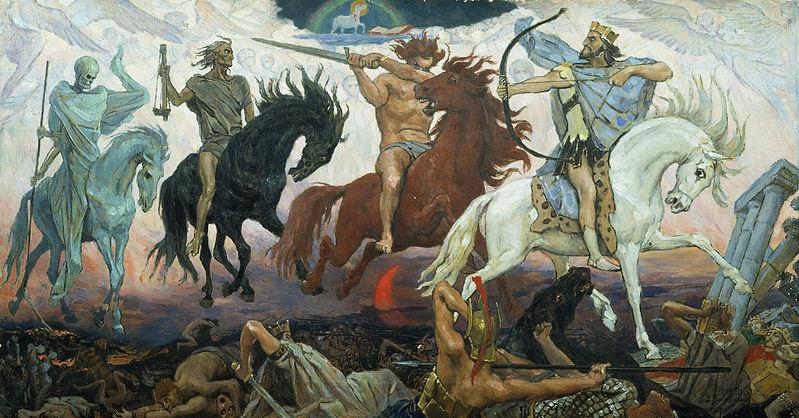
johnapocalypse

The Four Horsemen of the Apocalypse by Viktor Vasnetsov

End of Part One

On this note, I’d like to end the first post. This is in the main due to its length, I’d love to be able to cut it down as promised into two more readable parts.  Hopefully this has been a good first half and has sufficed as a good introduction to the book and its contents so far. In the next section, I will continue summarising the chapters to the best of my ability and commenting on them. These chapters delve much deeper into the what the author believes is the  underpinning of witchcraft and pagan belief, and how it can be channelled. I will then finish up with a conclusion and a final verdict.

Thanks again for reading,

~S-

A Small Ritual for Connecting with the Gods

Posted in Occultism, Paganism, The Path of Flames with tags , , , , , , , on August 11, 2013 by Sypheara

So it’s been awhile since the last post, and the book review for Apocalyptic Witchcraft still isn’t ready to go. As such, I’ve decided to post a small ritual write up in the meantime, that some may find useful or insightful. For those of you who are sorely tempted, I can say its definetly worth picking up, so don’t wait around and grab it whilst you can. On to the topic at hand however.

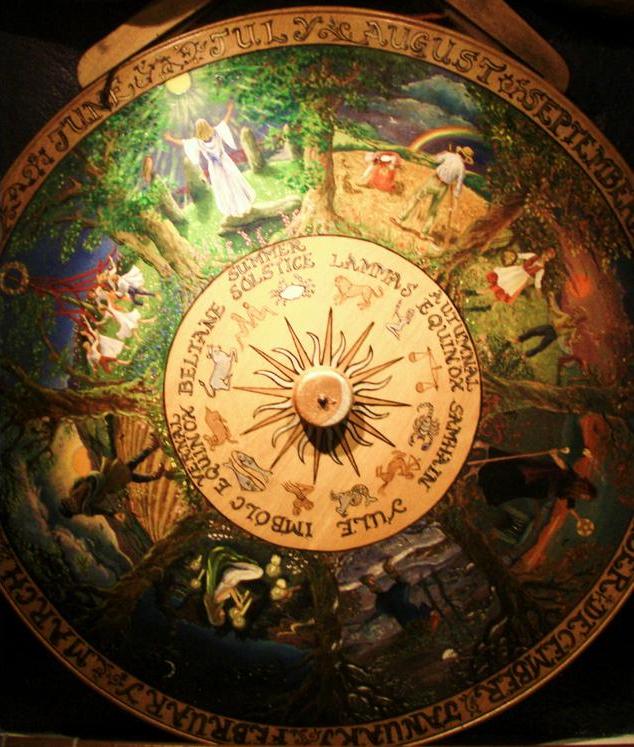
Recently, it was the time of of Lammas/Lughnasadh, an important Sabbat in the Wheel of the Year adopted by several neopagan groups.  For the non-witches, it is the  first of the Autumnal Sabbats which revolve around the Harvest. As someone who mostly observes the cross quarter days rather than the equinoxes, being away from home, and being the poor individual that I am, meant that I had to celebrate it in a relatively low key way using a ritual I’ve come to incorporate into my regular practice after utilising it on several occasions.

For me the Sabbats, regardless of their seasonal component, the most important part for them to me, is communing with the Gods. This small ritual is designed to allow that, and is one that can be varied to what works for the practioner. It is a ritual that facilitates a growing connection with the God or Spirit in question, and can also be used as a tool for both communication and the giving of offering.  It can be relatively extravegant, or startlingly simple. I will include the more complicated and simple variants together.  Note that, the optional parts, although optional, will greatly assist in obtaining concrete results.  It is best done on a night, so the method will assume this is the case.

It is to be noted the following is  what works for me, from personal experience.Although it contains elements from Path of Flames teaching, it also incorporates elements from other sources, and of my own creation. As such, it contains my own experiences and inferences, which will contain some non-objective observations although I’ve tried to keep them at a minimum. Feel free to experiment and modify it to something which gives you the most consistent results, but please do so with caution and within reason.

NOTE: The following does use blood. Its not massively vital, but I highly recommend it as it will help empower the work and act as a potent offering.

Materials

You will need only the basics for this ritual, but the more you add to it, the more you will get out of it. The following are the basics.

– Paper or equivalent for drawing on. Should be burnable.

– Ink suitable for use on the Paper/Parchment.

– Drawing implement or small paintbrush (for drawing with the ink).

– Pen/Pencil (if above two not used, otherwise not needed).

– Glass of Water (if using blood).

– Salt (if using blood).

– Relatively Sharp Knife (if using blood). This does not have to be dedicated in anyway to this purpose, as long as its cleaned. If you are of Wiccan background or otherwise use an Athame or anything of the sort , it is probably not good to use it for multiple practical and occult reasons to draw blood. Use a seperate blade instead.

– Three candles (optional, again as an offering and practically so if done in a dark, quiet room you can see without bright distracting artificial light)

– Relevent incense blend (optional) . Can substitute with tobacco or similar.

– Relevent libation (optional).

Preparation

Optional prestep: If you wish, you can consecrate the inks / use magickal inks of your own formula and also consecrate / prepare the parchment if you so choose. I mostly just use a consecrated standard ink, although I wish to make my own in the future that should be much more potent. I usually use paper that has been coated with coffee as a form of  ‘pre’ libation . If you can’t do these steps, again it should be ok, just the link will be weaker.

Not-so-optional pre-step: Wash the knife, preferably with something antibiotic. If you are really paranoid, or your immune system is weak and you are prone to infections, boil it in a pan for five minutes before draining and retrieving the knife. Dry with paper towels.

+ Prepare the area in which you work to be a space in which you feel comfortable, and relaxed. Set all the tools out somewhere easily reachable, in front of the three candles. If you have any other suitable images or icons / fetishes of the spirit/god/goddess in question, these may also be laid out in a manner you deem fit.

+ Draw the sigil of the God / Spirit you wish to contact upon the paper, using the brush/pen/pencil you are using. Once done, light the candles in the name of the God/Spirit you wish to contact and turn off any sources of artificial light.

+ Add the salt to the water, and stir. Place the knife into the water. This will have the affect of helping to purify the blade of any residual spiritual energies within it. This can also be dedicated if you wish, but it is really not essential in my experience and just adds additional complexity.

Optional Step: Clearing the mind utilising meditation upon the breath

Before you begin, you may wish to attempt to clear the mind of the daily background noise and thoughts which could cause distraction going into the working. This doesn’t have to be a prolonged or powerful meditative stage / phase, and is not a strictly necessary component. However I found it can help.

To perform it, in its basic fashion, is simple.  Sit in a comfortable manner, in a position where you can maintain your balance without issue.  You don’t need to unnecessarily force yourself into a straight uncomfortable position, but you should avoid leaning forward, back, left or right. Close your eyes, and visualise the thoughts slowly dissipating. There are numerous visualisations you can do to achieve this – one is to concentrate on the darkness, and imagine the thoughts melting into it and disappearing. Another, is to see a white light filling up your vision and pushing them from your mind. Experiment with what works for youself, as this is highly individual.

Once you have cleared your head of the majority of thoughts and feel relaxed, bring your attention away from this visualisation and to the sensation of your breathing. Don’t try and force the breath in an unnatural manner, but instead just concentrate on the feeling. Focus on a spot in the body where the breathing is easy to notice and fixate on the sensation.

Note its natural for the mind to wander. If it wanders off the sensation of the breath simply bring it back. Let your sensations such as thoughts, emotions and physical feelings all flow over you in the background of concentrating on the breath. When ready, you can move onto the next phase with a clearer mind.

Step One: Preparation for Visualisation and Charging the Sigil

+ Make your intent known. This is simply using your voice to call to the spirit. This should first address it by name, followed by giving praise to it, and then asking for its assistance in the visualisation/opening the veils between you and its nature.  It is important it is actually spoken however, and not just thought.

+ Optional:  If you have incense, burn it, and pass the paper over and through it several times (a number associated with the spirit in question in some manner can assist).

+ Optional: If you have a libation, this should be added to the sigil. It can be added in several ways. One, several drops can be spattered onto the sigil, again respecting a number associated with said spirit or god/goddess, if it is applicable.  Second, an equidistant cross can be drawn across the it, in a top to bottom, right to left manner. This further represents charging and unlocking the non mundane within the Sigil. 

+ Optional: If you are using blood, it can now be drawn. It is drawn by cutting open or pinpricking the Index, Middle, or Ring finger of the non dominant hand (the left is prefered). THIS DOES NOT HAVE TO BE A DEEP CUT.  Several drops of blood is all that is required, take great care in this. The blood is smeared onto the sigil. As with the libation, depending on the amount, this can be set amount of drops/smears, or done in a equidistant cross fashion.

logo2

Primary Sigil of Hecate, given to her practioners for those who walk the Path of Flames

Step Two: Visualisation

Sit comfortably in a similar position as the one you held for the breathing meditation.  Focus your attention entirely upon the sigil, and the marks of the libations and blood if you have used them.  Watch as the lines of the sigil become charged by not only the material elements, but also your concious will. Visualise the sigil glowing and flashing with light.

This light will often appear in a colour unique to the spirit and God/Goddess you are working with, and will not necessarily remain fixed. This can be due to the entity itself, or you mind settling in to the process before the primary type is fixated upom. For example. Hecates energy usually manifests as an emerald colour, but others can arise, such as a golden white light or a combination of both.  Keep gazing at the sigil until the shape seems burned into your eyes and mind.

Once you have reached this stage, close your eyes and fix your mind onto the shape. Watch as the colours of the lines of the sigil flow like it is alive in front of your eyes.  Meditate upon the sigil in a similar way to the breathing exercise, but instead with the sigil as a point of focus. Let the sigil change, take on new forms, and bring up images and memories rather than attempt to fight the process.

It is this process through which the gates and veils between yourself and the spirit in question will to some extent be opened. This in turn will allow messages to filter through to you and vice versa. It is both an active, and passive process, and one that has to be understood through practice. It is possible to experience dreamlike, lucid and visionary experiences from this alone.

If you feel yourself becoming less alert, bring your mind back to the sigillic shape. In case you lose the clear shape of the sigil, slowly open your eyes, reconcentrate on the sigil, and repeat the process.

Continue this cyclical process until it is time to stop. That will be an individual signal or feeling to the practioner. This could be a sign to stop entirely, or an invitation to continue, depending on the images/messages recieved. Again, this is down to your own experience.

BrightFullMoon

Step Three: Invocation

This next step is Optional, due to the inherent risks which can be associated with Invocation. Unlike evocation, with invocation the practioner becomes a medium for the spirit/god/goddess. This force will enter your body, and mind from within, and become one with you. For numerous reasons, this should be only attempted with spirits/gods/goddesses you have already had contact with and ascertained are suitable for working with in this manner. I have found this step will greatly enhance anything felt / encountered in the first section, and serves to turn the small dedicatory contact ritual into something quite powerful.  I present it here as a step to be done after the previous one, but it can actually be done at any point after the initial sigil work, and a connection made, even as its own seperate ritual. However, using it together with step two immediately after or on the following night has led to create good results for me.

I personally would only currently conduct this with the known spiritual teachers of the Path of Flames, and only generally after contact has been made through a successful evocation. I primarily show it here for those people who may have contacted a spirit/god/goddess they are comfortable with, and with to attempt it. I would only recommend it be done with Hecate to start with, but that is my own biases showing through.

The methodolgy listed is not entirely complete or comprehensive, but is still effective. To begin with, ensure a relaxed position. When ready, begin by stating outloud a prayer of Invocation. Usually this begins by calling to the spirit/god/goddess, giving it respect / praise, and then inviting it into ones body to energise and communicate with you. This call is not listed, as it will be specific to each individual spirit you wish to Invoke. This can be an individual one written, which is what I would recommend, unless you are following a particular current or tradition. In this case, it would be acceptable and appropriate to use that traditions formula of calling. Do not use a formula of calling of a tradition you do not belong to – usually these having specific uses, and can cause issues if you do use them.

Once the invocation has been made, close your eyes and visualise the spirit/god/goddess or its primary sigil/specific sigil. At this point, begin vibrating the name of the spirit/god/goddess you are invoking. To vibrate a word is something that has to be practiced and ‘felt’ to be effective. The basic method is to take a deep, prolonged breath, and then on exhalation, perform a prolonged chant of each syllable. Each syllable should have upwards of  several seconds devoted to stressig it. This is repeated alongside the visualisation. Ideally, for me, I find producing the chant from the abdomen and lower throat seems more effective, as I concentrate on building up each inhale to forcibly build the vibration on the exhale. The ideal, most resonant tone will be unique to the individual practitioner, and can also be different depending on the spirit/god/goddess you are working with. Slowly you should be able to feel the spirits presence growing.

The following effects can vary dramatically, and it must be remembered that we are not working within a circle to ensure reliable ensorcell/mediate but are instead working in direct contact. The possession can therefore range from mild to total. The beginning physical effects, for me when working with Hecate, is I feel a definite presence move from the top of the head along the spine, resulting in a pleasant, energising, and tingling sensation of the spinal nerves. This can get to the level of causing the spine to contract powerfully. This is accompanied with visions of Hecate, often to the point of near waking dreams. Communication can then be commenced, in multiple fashion, based on the intensity of the possession. Often this takes place within the vision, and is usually conducted in an externally or internally spoken manner. This is difficult to relate, and will only be really understood upon attemping it. At this point, if an additional offering is wanted to be made, or communion with the spirit/god/goddess driven to higher levels, sexual magickal union with the spirit can be attempted.

Eventually, after a period of time, the possessing force should of its own violition leave your body. If you wish to end the possesion early, the possessing force can be thanked for its presence and asked to leave. Once it has departed, the actual associated physical effects can take several hours to dissipate. In my case, the sensation of the spine being energised can be highly distracting, due to being on the border of both pleasurable and uncomfortable.  When this physical effect occurs in myself, it can take up to 6 hours to disperse and to return to pre invocation levels.

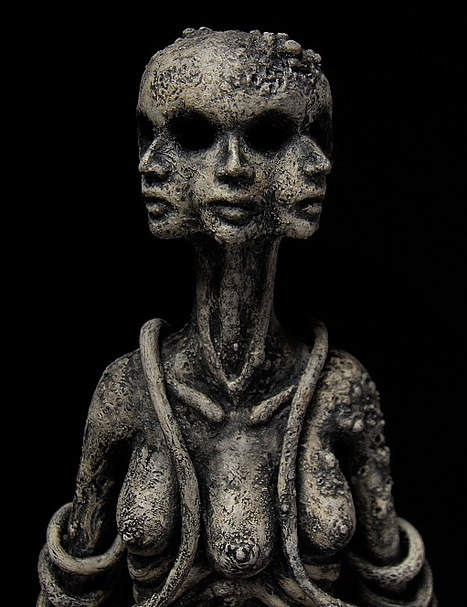
hecatedoll

Final Stage: Closing the Work

There is no need to officially close the work, as no circle or other working was performed that really needs to be closed, considering that the spirit/god/goddess in possession of your body will most likely have ‘left’ at the end of the preceeding phase. In addition, many of the spirits/gods/goddesses are invoked specifically to allow parts of themselves to remain within ourselves, increasing our connection to them and strengthening our subtle bodies.

This however, is the reason I warned against invoking potentially harmful spirits, as I have yet to come across any surefire way to remove this influence in my practices that would work for others. The best I could suggest were such a case was to arise, would  be to do a full invocation of Hecate asking for its removal combined with some other folk magickal techniques.

It is important to ground yourself afterwards, in order to bring your mind back to Earth and ensure that everything settles. I find this is best performed by eating and / or drinking something, which has the additional benefit of helping top up physical energy reserves which can be depleted during any work with the spirits/gods/goddesses which you could contact.

The candles themselves are offerings, so should be left to burn down entirely, and should not be extinguished early and/or removed.

The final step is to dispose of the sigil. This should be done with care and respect, as it is technically still activated and will possess an actual power until it is uncreated, despite weakening over time if not repeatedly strengthend. This can cause it to have continuing effects, until the work is fully complete.

To this end, the sigil is offered to the spirit, god, or goddess you are working with by name, whereupon it is set alight. This is ideally done sometime before the following sunrise.  I personally do this in front of a Holly Bush, and use the ashes to help fertilise the tree.

burning-paper

Conclusion

I hope this is a good introduction to some of the methodology I use within work. It’s what i’ve tried, and adapted, that seems to work for me, and with luck maybe someone else will be able to take something away from it and add it to their own practice.

If you have any questions, don’t hesistate to comment and I’ll try and answer to the best of my ability.

-S-

The Lines of Power: Part Two

Posted in Folk Belief, Occultism, Paganism, The Path of Flames with tags , , , , , , , , , on June 15, 2013 by Sypheara

So here it finally  is, the second part of the Lines of Power post I’ve been meaning to. This is going to be another long post, due to covering several topics, so grab yourself a coffee – you might need it to make it through!

Addendum: Leylines – Astrological Significance

Firstly, I’d like to quicly and briefly summarise that, outside of the original post’s conclusion, I do believe that SOME ley lines lie along paths of astrological significance. It is now widely accepted by the mainstream that these sites were often made specifically to identify, track, and even measure the cycles of the celestial planets. As such, it would of course make sense that certain sites are aligned along paths which facilitate this. These lines would be the exception to the examples talked about in the prior posting – these sites would necessarily have to be located along the same line, marking a real, tangible line of influence. With that said, this wasn’t the point of part two, so I’ll leave that for other people to discuss/research and keep this as a small sidenote.

Earth’s Magnetic Field

The most easily observable Lines of Power I will mention here is arguably those of Earth’s magnetic field. I have included it here to ground the other topics and to illustrate the great physical influence these have on human life and the biosphere.

Magnetic fields are produced by the motion of electrical charge. This can be seen in a humble bar magnet, where the magnetic field results from negatively charged electrons moving from one pole to another. The Earth similarly has a magnetic field. Whilst its origins are poorly understood, it is believed that the electrical currents are produced by convectice effects and rotation in the liquid, metallic outer core which is comprised of iron and nickel.

This field is constantly present but can vary considerably with time. Rocks such as basalt that are formed from a molten state preserve indicators of the magnetic field when they eventually solidify. This allows geologists to observe how the magnetic field has changed over time. These indicators show that the flow of the field is not constant, varies in strength, and has gone through several cycles of reversing the direction of its flow.

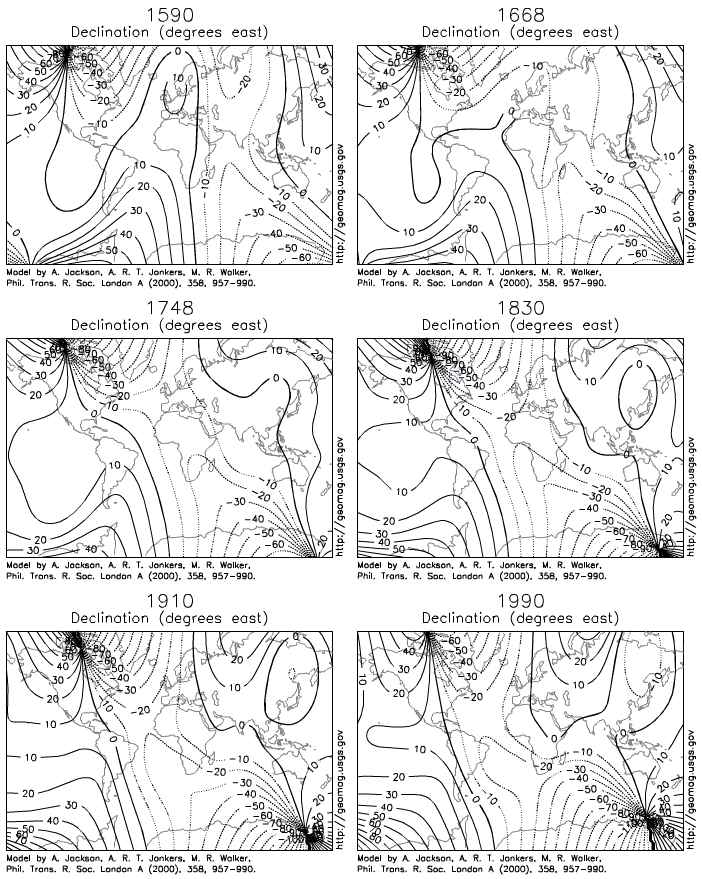
The actual poles of the field do not correspond to true north and true south, and the poles are known to wander, presumed considerably so before a reversal. This causes a declination in the magnetic field lines, which can be measured to be significant over a few hundred years.


Earth’s magnetic field is vital to life.  Our sun produces larges amount of radiation, in the form of Solar Wind. Solar Wind is not wind at all, but instead a powerful stream of of charged particles consisting of electrons and protons. These are released from the upper atmosphere of the Sun, and can be exceptionally damaging especially during intense periods of solar flare activity. Thankfully the presence of Earth’s magnetic field prevents the atmosphere from being stripped away into space, and the surface from being heavilly irradiated. Even so, the harsh battering the planet receives is enough to distort the magnetosphere significantly, as shown in the image below.

This is not the only effect the magnetosphere has however. It is known that many organisms on Earth make use of the magnetic field for numerous purposes, in what is known as Biomagnetism. Biomagnetism plays an important role in the lives of many species.

A powerful example of how it affects organisms would be in a class of bacteria known as magnetotactic bacteria. These organisms demonstrate a behaviour in which they orientate themselves and migrate along the Earths magnetic field lines. These bacteria are said to be permanantly sensitive to the fields, due to them containing magnetosomes which act as a magnetic dipole, preserving the crystalline structure of cells.

Other examples can be seen in even more complex animals, including various mammal and bird species. In these cases, the magnetic field of the earth is used as a natural inbuilt compass, to help guide the animal in some manner, as either a map, a compass, or a compass calibrator.

In addition, there are several studies that show that the Earths magnetic field can have influence upon the human brain.  Studies on the possibility of a human magnetic sense being present has been conducted, with mixed results. It is known however that humans possess magnetic bones in the human nose, and another recent study showed that low-frequency magnetic fields can produce an evoked response in human subjects.

It is interesting to note that strong magnetic fields can cause hallucinations, such as the feeling of being watched, and are in some cases are seen by some to play a part in several hauntings. It does therefore not seem too far fetched to believe that magnetosphere has some kind of psychological influence. I will leave that topic for further exploration another day however.

Song Lines/Dream Lines

In Aboriginal Australian belief, there exists a concept of the Song Lines or Dream Lines. These lines, also known as Dreaming Tracks, are paths across the land and sky which mark the route followed by localised creator spirits, during the Dream Time. The Dream Time was a sacred era in which it is believed that the ancestral totemic spirit beings created the world, making these lines actual lines of spiritual power.

These paths are recorded through traditional songs, stories, dance and paintings. By recalling these paths in song or through other methods, the indigenous people could navigate vast physical distances, travelling often through the harsh deserts that make up the centre of Australia. The continent is said to contain an extensive system of Song Lines. Some of these are only a few kilometres long, whilst others are travel hundreds of kilometres, crossing several different territories owned by differing indigneous tribes.

Someone who is knowledgeable of the lines and able to recall them in this manner is able to see the marks of the Spirits. Repeating phrases and words in song that describe of the location of landmarks such as waterholes and other natural phenomena enables them to follow the Song Line. In many cases it is said that the paths of the creator spirits is obvious from their marks on the land, such as large depressions or other signs which are said to be of their footprints, body marks or other indicators of their physical presence.

Some Song Lines have strict taboos or rules surrounding them that are observed religiously. For example, some Song Lines are thought to have a particular direction, and walking the reverse way along such a Song Line is seen as a sacrilegious act.  This is difficult to at first appreciate the severity of, but when one investigates how Traditional Aboriginal people regard their land sacred, and them as guardians it begins to make much more sense. The Aboriginal people believe that the songs must be continually song of the lines to keep the land alive, and working against and damaging the Song Lines is obviously seen in a bad light.

In both these posts I have now covered several examples of different Lines of Power, I will now go onto detailing the teaching my own Path has on this, alongside my own personal interpretation which will hopefully wrap it all up in a cohesive way.

Path of Flames Teaching and My Interpretation

The Path of Flames has its own take on Lines of Power, in the form of the Dragon Lines. These Dragon Lines are in a way similar to the Lung Meis or Dragon Paths as seen within the Chinese belief of Feng Shui.

In the Path of Flames, Belial is the God associated with the material plane. The material plane itself is the actual body of the God, and the Dragon Lines in our tradition are the actual spiritual vessels for this Gods lifeforce, analogous in some ways to the blood vessels within our own body.  It facilitates the travel of spirits and the transfer of spiritual power, and exists as a system connecting our world to the astral and the Gods. Without it, similar to the concept of the Dream Lines, we believe the world would begin to literally wither and die.

It is currently the task of those who follow Hecate and the Path of Ascending Flame to work with reinvigorating the Dragon Lines by earthing the currents found through spiritual practice. It is believed that by each individual in this manner bringing back more of the teachings and power, and feed them back into the Dragon Lines, that a much stronger spiritual age can be ushered in and humanity can reconnected with its spirits on a larger level.

Its name as the Dragon Lines is also apt, as the Dragon spirits of the path use it to travel and manifest. The Earth Dragon, Behemuth, draws alot of its power from the lines and travels along them as one of Belials most impressive and powerful servants, and is an entity that I look forward to personally working with in the future.

When this is viewed in the context of the Lines of Power revealed in my previous posts, I can now say my own view and theory on the subject. I believe that, whilst the Dragon Lines themselves exist as a spiritual (but physically existing) system, that some (if not all) of the Lines of Power mentioned also belong to this system as different manifestations of it. By this, I mean that I believe that each of these systems combines to make up the manifestations of the body of Belial, and in essence, are all differing types of Dragon Line.

In this way, I believe the nature of the system has untapped potential for exploration in much greater detail, and I’m looking forward to possibly uncovering more in the future through practical means.  By investigating each set of Lines, I hope that in the future that how each Line operates, and interacts, with the others can be explained in greater detail. I hope this is done through respecting the complexity of the systems involved, rather than trying to merge through over syncretic action separate modes of action (such as how Ley-Lines became confused with the Dragon Line/Song Line concepts in New Age thought).

Hopefully this has been a little primer.. and revealed what directions my thoughts are going on it.

Thanks as always for reading.


The Refusal of Death Within Modern Western Society

Posted in Necromancy, Other, Paganism with tags , , , , , on May 16, 2013 by Sypheara

I recently stumbled across an interesting video on BBC News relating to georgian families visiting graveyards and holding feasts within them for their deceased family members. It was highly interesting, not really for what it said in the actual video but more the presenters reactions and the fact that this video was made as a curiosity piece in the first place.  This thought  got me remembering a topic I’ve givrn alot of consideration in the past, which is really two issues which play off of each other. So I can launch into it, I will link the video below so you can see it for yourselves.

Firstly, I just want to point out that, whilst the georgian families depicted are in fact Orthodox Christian, the practice of going to burial sites and leaving offerings, feasting with the dead, and other similar practices is nothing unique to them. It has been carried out and is carried out in many religions, and I would also contend that, in the majority of Pagan paths both new and old, the same kind of veneration is in some way present.  As such,  I’m using it to highlight modern social attitudes to the subject on a deeper level.

This ‘attitude’ that I mention is none other than the devaluing of death and its place in the world and the wool being drawn down over peoples eyes instead. This has, I would argue, had the impact of making the subject taboo within modern western culture, which has resulted in an overall unhealthy attempt to suppress it despite it  being an unescapable fact of life. In many countries, it would now be impossible to celebrate death as a part of life how the Georgians did above in the video, for the fear of being labelled strange, out of place, or macabre. I attempt to cover why I think this could be the case in this post.

My target is the modern culture we live within, which has seen seen the rise of antispiritual sentiment and suppression on a large scale. This in turn has led to a disconnection between us and our world, and this death aversion I would contend has led to a widespread psychological issue on the cultural level. To explain this, I will cover two approaches to how the universe can be seen. These are linear, cyclic respectively.

Many belief systems, especially Pagan ones, either see existence as being cyclical or incorporate some ideas from this basic concept.  An example of this  which is usually given is the natural cycle of the seasons, which can be seen demonstrated in the modern contemporary interpretation of the wheel of the year. In Wiccan belief, the common narative for the Wheel of the Year is that of the Horned God and Goddess. Horned God is born from the Goddess at Yuletide, comes of puberty at the vernal equinox, impregnates the Goddess at Beltane, reaches his full strength at the summer solstice, ages at Lammas, and  finally, dies and passes  into the underworld at Samhain. The cycle begins again, as he is once again resurrected and reborn at Yuletide to continue the cycle. These narratives and observations are seen to be the microcosm of a macrocosmic truth which asserts that the universe consists entirely of such infinite life cycles, all important to the other in eternal change.

Seen from this perspective,  it explains the approaches surrounding death within such belief systems that hold to this cyclic truth. Death is seen here as a transition not a final end, a metamorphosis of sorts.  Just like one season transitions to another, rather than nonexistence, so to does the person who has died. Whether their destination is the underworld, some form of heavenly afterlife or to be reincarnated, is usually up to the individual belief system. An example of this can be seen in the Norse concept of the Ragnarök, where the world would be destroyed,  and be remade and repopulated. Not even the Gods would be immune to the hand of change in this event, which it was said would cause  several of the major Gods (including Odin and Thor) themselves to die because of it. Even the Christians, inspired by earlier beliefs, still hold that the Earth will be eventually judged, destroyed, and then remade into a new Heaven and Earth.

wheeloftheyear1

In modern contemporary culture,  this is however not the prevailing case, where such interpretations were challenged by the rise of philosophical concepts that arose in the Enlightenment period such as Secular Humanism. A product of the enlightenment age, Secular Humanism is the position that human reason, and philosophical naturalism, are the basis for morality and decision making. Whilst supposedly an essential part of secular humanism is a continually adapting search for truth, it rejects completely the notion that  spirituality is essential to the human experience and that truth can be gleaned from spiritual practice.

Whilst this did have the positive effects of freeing us from the dogma that was enforced under the bootheels of a militant christianity, in the end it would end up evolving into its own ‘naturalist’ dogma  of sorts which has gone on to have a profound impact.

The cyclic model was thus slowly replaced and eroded into a new model, that instead concluded that infact fact reality was a linear construct and not cyclical, progressing along a line with a definite Beginning, and a definite End, without necessarily leading to new creation.  This, coupled with the correspoding rise in antispiritual sentiment led to a repression of the former dissenting world view. With this scale the concept of death and destruction changed,  becoming final instead of part of a cycle. This resulted  in the confrontation with Nothingness and the concept of Eternal oblivion.

Faced with the meaningless of life and the concept of eternal oblivion, the philosophy of Existentialism was born, which posits that an individual is responsible for imposing their meaning onto their own lives in what is essentially, an apparently meaningless, insane and absurd universe. A world that began without cause, and will end without cause, with the only meaning in a  persons life being defined by the individuals themselves.  For many, this position leads to that of Existential Nihilism, where the intrinsic meaning given by an individual is not sufficient to replace the fact that life has no intrinsic meaning or value. It is well summed up by a section of text from “The Specter of the Absurd: Sources and Criticisms of Modern Nihilism” by  Donald A. Crosby. “Strut, fret, and delude ourselves as we may, our lives are of no significance, and it is futile to seek or to affirm meaning where none can be found.”

hourglass

When faced with such a bleak outlook, its not surprising such a taboo regarding death slowly seeped into western culture. No longer was it a  transitory stage, but the extinguishing of a person. It became something to be shunned, something to be not looked at or investigated, in a a way that ironically smacks of  superstitious fear. Don’t talk about it, don’t invoke it. By being out of sight and out of mind, the concept of Eternal Oblivion hangs like a spectre over many today whose only answer to it is that they ‘choose not to think about it’ and shove their heads into the sand in terror. From this, it’s also not surprising to see that in such modern ‘advanced’ cultures that things such as harmful live for the moment  lifestyles,  widespread ecological damage in the name of profit, and a false belief in transcendental technological salvation come about alongside sky rocketing suicide rates, amidst a growing cloud of unrelenting cynicism and depression.

However, Man is not cast adrift into life like a shipwreck survivor onto an island, who can only ‘make do’ with his woeful fate and  stamp his feet in anger and nash his teeth until death claims him. This thought is nothing short of modern psychosis. I hope one day people can see this, and that scenes such as these shown by the BBC from Georgia could occur in my own ‘fair country’ of England’, instead of being seen as some weird, alien ritual that we seem to be incapable of understanding.

I  wish I could express the same desire publicly as they do, I wish others could even approach the subject with seriousness and not disgrace the memory of their dead by forgetting they ever existed.

I’ m not holding my breath.

The Witchmark and Blood Offering

Posted in Paganism, The Path of Flames with tags , , , , , , , , , on May 12, 2013 by Sypheara

This entry is going to be more personal than the previous, and due to it’s nature I can’t possibly put everything into this post in an objective manner.

Yesterday was a very special day for me, as it was the day that finally, after several years of research and practice I went ahead with a very important work, one which seals all my initiatory work up to this point and marks the beginning of a whole new phase for me.

This work I speak of was planned awhile ago, with not a small amount of trepidation involved. For three years up until that fateful point several months ago, I had approached the Gods and conducted several works with them, mini initiations which  brought me closer to identifying their energies, and aligning myself to them as someone who felt called to interact with them.

As these initiations guided me to my current path, I slowly began to learn that a true sacrifice was necessary outside of these small dedicatory rituals. True initiation, one would say, into the path I was being called upon to practice.

It was then I came across the notion of the Witchmark within my own tradition. Whilst a quick google would probably indicate to the reader this ideacame from the idea of the ‘Devils Mark’, this is not the case. This ‘mark’ is a physical mark on the body which is believed causes a corresponding mark on the soul of the person who receives it, serving as a first true initiation. The mark itself takes the form of a sigil of some kind, usually a primary one, and it is usually tattooed or scarified into the skin. This is more akin to the beliefs held by many pagan people in the past, where marking the skin for similar purpose is  shown to exist across many different cultures.

I’ll briefly divert to explain an important concept to be able to understand the importance of this as far as my own tradition goes, and it touches a subject again many don’t like to talk too openly about.

This subject is using blood offerings. It’s important to note that my own tradition sees the bodily fluids of the practitioner as being vessels for not only ones own essence, will and spirit but also that of any entities which are working through that person in possession at the time they are extracted. When coupled with my belief in the importance of personal sacrifice in works with the Gods and the concept of ‘you don’t get something for nothing’,  i’ts easy to see why the necessity of using my own blood in ritual became obvious to me.

By using  blood as both tool and offering,  we give actual power through it into our workings. This is where my (albeit limited) knowledge and respect of folk magical traditions come to the fore and what it has to say on this matter; I do not believe that, as many modern day pagans and occultists do, that such components only have psychological value. I contend they have a very spiritual and physical effect from the workings I have done that makes it a vital component in the majority of workings.  This view is relatively unpopular in many circles today (pardon the pun), but is one that makes any discussion on the Witchmark vital to understand from my own perspective, and thus unavoidable in this post.

Despite this, the the leap between using drops of my own blood in ritual up to this point and actually going as far as to take the plunge and have my own Witchmark, the primary sigil of Hecate, tattooed onto my body was a large one. With the sigil in place, it would be impossible to remove it – or at least physically difficult and spiritually permanently scarring. As such, I deliberated for awhile before deciding to ask Hecate directly for a response. The response to that half thought of a question that night was immediate, as I was surrounded and penetrated by a powerful, overwhelming force that seemed to permeate my entire body. Taking it as a sign, I finally came to my mind. I’d take the plunge and go through with it.

Using my intuition to guide me, I decided that the Witchmark would be placed over the sternum enabling two things. Firstly, that the Witchmark was placed as close to the centre of the chest as possible, over the region of the heart, seen in many cultures as a powerful energy centre of the body in some manner. Secondly, that the Witchmark would be out of sight, preserving it as a esoteric tool and mark in respect, not ‘displaying’ it in a show off my ego to the world.

every once in a while in your life you reach a decision point. a crossroad leading left or right. you can not look far enough to make the perfect step, but you have to decide anyways. is it left or right? or even turning back?

So yesterday I found myself on ‘the day’ of getting it tattooed onto my body. At this point, before hand, I was glad I was fully prepared, mentally at least, to receive it. The actual process was more painful than initially expected due its location (I was actually encouraged to get it placed elsewhere first!), but in the end it was strangely enjoyable in its own fashion. I tried visualisation several times, with only a small amount of success due to the environment coupled with the distracting pain. I saw flashes of images and sigils, but nothing concrete that I could work with or record for long in memory during the procedure. I eventually gave up and just began repeating a small mantra to Hecate in my head whilst the ink was applied.

After it was successfully applied I got up legs shaking, feeling born anew. Although physically exhausted, both mentally and spiritually I felt indescribably  heightened and sharpened. My body, mind and soul felt like they were screaming with vibrancy. A day later the effect still hasn’t worn off, and I still feel ecstatic, and have dreamed vividly.

I feel honoured to be able to receive this mark as a gift, and make that blood sacrifice in return as a sacred offering to Hecate which is the first step in a new direction on my journey. I hope to explore the paths unlocked by this sacred key, and share what I am able to.

With this being new territory to me, I thought it was more than worthy of a mention on the blog. I hope this post has been interesting and potentially shed some light on why it is seen as a necessary to my own path. I wish I could post more concretely about my own experience with it , but with it being such a new development I cannot really say much more as it would be a fabrication.

As a parting note, I’d like to say that I found an excellent post by another guy on his own similar experience which can be found at the following link, that shows anothers point of view on the subject. Whilst I don’t usually relate to many of the posts that go up on this site, this one definitely caught my eye.

http://www.witchvox.com/va/dt_va.html?a=usla&c=words&id=15349

Thank you as always for reading.

Syncreticism: When is it useful, when is it hurtful?

Posted in Occultism, Paganism with tags , , , , , , , , on May 10, 2013 by Sypheara

So I’ve been mulling over the next topic to bring up.. and this important one popped into my mind. As someone who worked primarily as an eclectic in some sense until relatively recently, it was always something that I continually took to be a subject of high importance as I approached my workings.

Syncreticism is best and most quickly described as the ‘Reconciliation or fusion of differing systems of belief, … , especially when success is partial or the result is heterogeneous.’. This  means in the terms of Paganism and Occultism the combining of different spiritual beliefs, and often actual practices, of  various traditions at the same time into a new form.

Commonly, these traditions are originally discrete practices or currents,  unconnected in any manner, separated often geologically, culturally and temporally, but slowly became incorporated into each other over time. An example of these types of hybrid beliefs which can grow from the merging of two forms of belief are possibly best found in the New World. Here, a myriad of  religions exist which arose from the combination of multiple belief systems. An easy case to point to would be something like Santería, which is the result of a  mixture of Yoruba, Native American and Catholic belief systems.

In modern Pagan and Occult circles, it can be often seen that there are high degrees of syncreticism, no doubt as the result of the easy access  to information caused by the coming of age of the internet. Whilst some of this works, and works well, other examples (which I won’t point out as causing offence isn’t the sake of the blog..) clearly does not, and in my opinion causes more harm than good.

So where do we draw the line? Whats helpful, and whats hurtful? Unfortunately, drawing that line is  on a very case by case basis.

A low level syncretic approach I would argue is vital. The search for analogues of your own practices and beliefs in other, differing currents allows for an insight that would otherwise be lost. Looking at other currents allows for each practitioner to potentially see where it intersects with his or her own teachings, which in turn allows for the revelation of new ideas and relations which may have, in a broad sense, have an enriching effect on their own beliefs and practices.

In this way, the philosophical insights from those other currents can be incorporated into ones own and potentially allow for its expansion and growth by challenging, confirming, or placing a different light on ones own beliefs.

maxresdefault

As soon as we begin leaving this territory however, things become much murkier and difficult to assess. When it come
s down to taking different rituals and mythological/theological ideas from different currents and combining them into a new form that utilise this ‘home brew’ , I would argue there is a very large possibility of utter disaster if it is not thought through with the most utmost care.

Even very ‘similar’ currents on the exoteric level can be significantly different on the esoteric level, causing  substantial problems in the long run. In the best case where two mostly incompatible currents come together, one element becomes dominated by the other, and becomes passive, having little effect in enriching the original tradition.  In the worst case however, the new combination just serves to show extreme disrespect to the currents being ‘forced’ together, and will either be entirely ineffectual or even harmful to the practitioner/practitioners who utilise it. The last is most likely to come from attempting to combine two very disparate belief systems.

An example of this to make the point clear is that, as someone who works with Hecate I would never use the name of Kali or Inanna for example within my tradition. Although connections between them exist, and one could even make a convincing argument that they are faces of potentially the same force, it would be wrong to use them within a ritual context as each face comes also with its own individual signature which marks it as its OWN current. This signature is influenced by the culture, and time period, it was originally conceived within and will undoubtedly come with additional influences which do not allow for them to be combined within the same working or potentially even the same framework.

The exception, I would say, is if the practitioner of a current was told otherwise through direct spirit work, with his or her Gods  or equivalent. Such instruction, if from a genuine source, should not be resisted as multiple, new, powerful ideas, concepts and paths have arisen from this process.

In conclusion, I do believe that overall Syncreticism is a highly important part in what makes Modern Paganism and Occultism feel alive and dynamic. It has definitively enriched my own practice, which will be seen throughout my further blog posts. However it is something that must be approached very carefully, with proper thought given to the above considerations without haste, recklessness, and disrespect to the traditions involved.