The Lines of Power: Part Two

Posted in Folk Belief, Occultism, Paganism, The Path of Flames with tags , , , , , , , , , on June 15, 2013 by Sypheara

So here it finally  is, the second part of the Lines of Power post I’ve been meaning to. This is going to be another long post, due to covering several topics, so grab yourself a coffee – you might need it to make it through!

Addendum: Leylines – Astrological Significance

Firstly, I’d like to quicly and briefly summarise that, outside of the original post’s conclusion, I do believe that SOME ley lines lie along paths of astrological significance. It is now widely accepted by the mainstream that these sites were often made specifically to identify, track, and even measure the cycles of the celestial planets. As such, it would of course make sense that certain sites are aligned along paths which facilitate this. These lines would be the exception to the examples talked about in the prior posting – these sites would necessarily have to be located along the same line, marking a real, tangible line of influence. With that said, this wasn’t the point of part two, so I’ll leave that for other people to discuss/research and keep this as a small sidenote.

Earth’s Magnetic Field

The most easily observable Lines of Power I will mention here is arguably those of Earth’s magnetic field. I have included it here to ground the other topics and to illustrate the great physical influence these have on human life and the biosphere.

Magnetic fields are produced by the motion of electrical charge. This can be seen in a humble bar magnet, where the magnetic field results from negatively charged electrons moving from one pole to another. The Earth similarly has a magnetic field. Whilst its origins are poorly understood, it is believed that the electrical currents are produced by convectice effects and rotation in the liquid, metallic outer core which is comprised of iron and nickel.

This field is constantly present but can vary considerably with time. Rocks such as basalt that are formed from a molten state preserve indicators of the magnetic field when they eventually solidify. This allows geologists to observe how the magnetic field has changed over time. These indicators show that the flow of the field is not constant, varies in strength, and has gone through several cycles of reversing the direction of its flow.

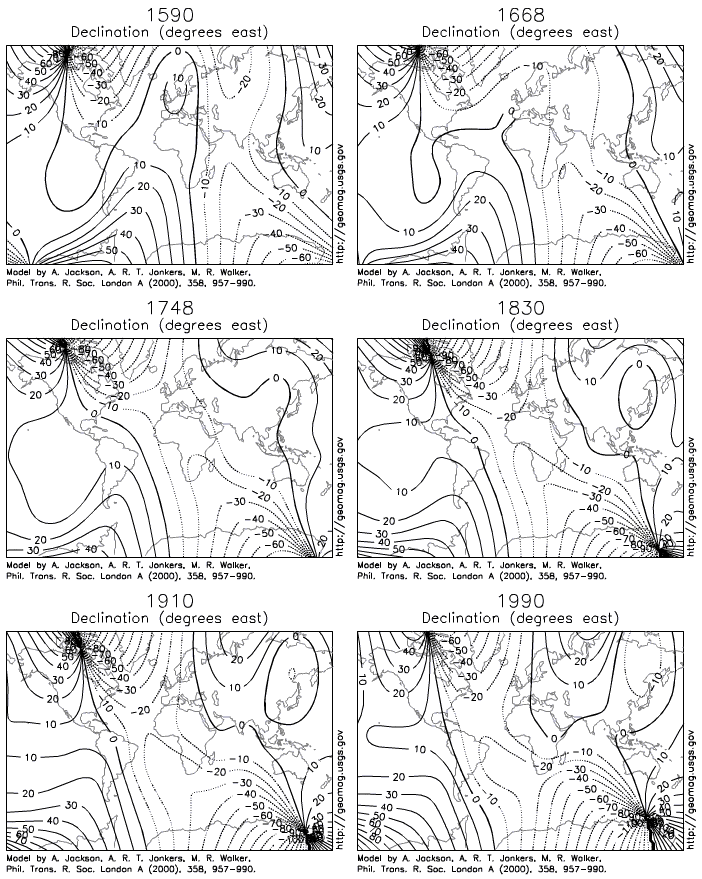
The actual poles of the field do not correspond to true north and true south, and the poles are known to wander, presumed considerably so before a reversal. This causes a declination in the magnetic field lines, which can be measured to be significant over a few hundred years.

Earth’s magnetic field is vital to life.  Our sun produces larges amount of radiation, in the form of Solar Wind. Solar Wind is not wind at all, but instead a powerful stream of of charged particles consisting of electrons and protons. These are released from the upper atmosphere of the Sun, and can be exceptionally damaging especially during intense periods of solar flare activity. Thankfully the presence of Earth’s magnetic field prevents the atmosphere from being stripped away into space, and the surface from being heavilly irradiated. Even so, the harsh battering the planet receives is enough to distort the magnetosphere significantly, as shown in the image below.

This is not the only effect the magnetosphere has however. It is known that many organisms on Earth make use of the magnetic field for numerous purposes, in what is known as Biomagnetism. Biomagnetism plays an important role in the lives of many species.

A powerful example of how it affects organisms would be in a class of bacteria known as magnetotactic bacteria. These organisms demonstrate a behaviour in which they orientate themselves and migrate along the Earths magnetic field lines. These bacteria are said to be permanantly sensitive to the fields, due to them containing magnetosomes which act as a magnetic dipole, preserving the crystalline structure of cells.

Other examples can be seen in even more complex animals, including various mammal and bird species. In these cases, the magnetic field of the earth is used as a natural inbuilt compass, to help guide the animal in some manner, as either a map, a compass, or a compass calibrator.

In addition, there are several studies that show that the Earths magnetic field can have influence upon the human brain.  Studies on the possibility of a human magnetic sense being present has been conducted, with mixed results. It is known however that humans possess magnetic bones in the human nose, and another recent study showed that low-frequency magnetic fields can produce an evoked response in human subjects.

It is interesting to note that strong magnetic fields can cause hallucinations, such as the feeling of being watched, and are in some cases are seen by some to play a part in several hauntings. It does therefore not seem too far fetched to believe that magnetosphere has some kind of psychological influence. I will leave that topic for further exploration another day however.

Song Lines/Dream Lines

In Aboriginal Australian belief, there exists a concept of the Song Lines or Dream Lines. These lines, also known as Dreaming Tracks, are paths across the land and sky which mark the route followed by localised creator spirits, during the Dream Time. The Dream Time was a sacred era in which it is believed that the ancestral totemic spirit beings created the world, making these lines actual lines of spiritual power.

These paths are recorded through traditional songs, stories, dance and paintings. By recalling these paths in song or through other methods, the indigenous people could navigate vast physical distances, travelling often through the harsh deserts that make up the centre of Australia. The continent is said to contain an extensive system of Song Lines. Some of these are only a few kilometres long, whilst others are travel hundreds of kilometres, crossing several different territories owned by differing indigneous tribes.

Someone who is knowledgeable of the lines and able to recall them in this manner is able to see the marks of the Spirits. Repeating phrases and words in song that describe of the location of landmarks such as waterholes and other natural phenomena enables them to follow the Song Line. In many cases it is said that the paths of the creator spirits is obvious from their marks on the land, such as large depressions or other signs which are said to be of their footprints, body marks or other indicators of their physical presence.

Some Song Lines have strict taboos or rules surrounding them that are observed religiously. For example, some Song Lines are thought to have a particular direction, and walking the reverse way along such a Song Line is seen as a sacrilegious act.  This is difficult to at first appreciate the severity of, but when one investigates how Traditional Aboriginal people regard their land sacred, and them as guardians it begins to make much more sense. The Aboriginal people believe that the songs must be continually song of the lines to keep the land alive, and working against and damaging the Song Lines is obviously seen in a bad light.

In both these posts I have now covered several examples of different Lines of Power, I will now go onto detailing the teaching my own Path has on this, alongside my own personal interpretation which will hopefully wrap it all up in a cohesive way.

Path of Flames Teaching and My Interpretation

The Path of Flames has its own take on Lines of Power, in the form of the Dragon Lines. These Dragon Lines are in a way similar to the Lung Meis or Dragon Paths as seen within the Chinese belief of Feng Shui.

In the Path of Flames, Belial is the God associated with the material plane. The material plane itself is the actual body of the God, and the Dragon Lines in our tradition are the actual spiritual vessels for this Gods lifeforce, analogous in some ways to the blood vessels within our own body.  It facilitates the travel of spirits and the transfer of spiritual power, and exists as a system connecting our world to the astral and the Gods. Without it, similar to the concept of the Dream Lines, we believe the world would begin to literally wither and die.

It is currently the task of those who follow Hecate and the Path of Ascending Flame to work with reinvigorating the Dragon Lines by earthing the currents found through spiritual practice. It is believed that by each individual in this manner bringing back more of the teachings and power, and feed them back into the Dragon Lines, that a much stronger spiritual age can be ushered in and humanity can reconnected with its spirits on a larger level.

Its name as the Dragon Lines is also apt, as the Dragon spirits of the path use it to travel and manifest. The Earth Dragon, Behemuth, draws alot of its power from the lines and travels along them as one of Belials most impressive and powerful servants, and is an entity that I look forward to personally working with in the future.

When this is viewed in the context of the Lines of Power revealed in my previous posts, I can now say my own view and theory on the subject. I believe that, whilst the Dragon Lines themselves exist as a spiritual (but physically existing) system, that some (if not all) of the Lines of Power mentioned also belong to this system as different manifestations of it. By this, I mean that I believe that each of these systems combines to make up the manifestations of the body of Belial, and in essence, are all differing types of Dragon Line.

In this way, I believe the nature of the system has untapped potential for exploration in much greater detail, and I’m looking forward to possibly uncovering more in the future through practical means.  By investigating each set of Lines, I hope that in the future that how each Line operates, and interacts, with the others can be explained in greater detail. I hope this is done through respecting the complexity of the systems involved, rather than trying to merge through over syncretic action separate modes of action (such as how Ley-Lines became confused with the Dragon Line/Song Line concepts in New Age thought).

Hopefully this has been a little primer.. and revealed what directions my thoughts are going on it.

Thanks as always for reading.


Lady Datura

Posted in Occultism, Other with tags , , , , , on June 6, 2013 by Sypheara

So this week has been busy, little time to get on formulating part 2 of the Lines of Power post.. it is coming, I promise! In the meantime, I thought I’d post a small interim post.

I came across an interesting poem whilst reading up on Datura plants and their effects. I always been interested in researching entheogenic plants, for numerous reasons, especially ones that possess a link to darker themes and attributes.  The Daturas, and the Solanaceae in general, have always struck me as highly interesting plants not just because of the folklore and history surrounding them but also their actual physical effects, where are worlds apart from the more abused plants that induce simple euphoria.

I don’t take any credit for the following poem, I just happened to stumble across it and like it. The picture is a sculpture from a deviant art user, but unfortunately I saved it along time ago and I cannot remember who made it. Kudos to them though, it’s excellently dark.

Original link and full text:  http://worldvoices.pen.org/dramatic-writing-play/datura-dramatic-poem

Datura: A Dramatic Poem (extract)

by Matthew Raab

‘Many before me have died
trying to experience this emotion
The remedy for this perception
was created in this potion
The poison in her veins
didst open wide the doors
Knowledge holds the reigns
to the visionary core
Bliss has a thousand Faces
and twice as many eyes
Obtain the Sky God’s graces
then you will hold her prize
I took a three day trip
in a vehicle of Angel hair
Across the galaxy of Zen
but took no plane to get there
I landed in a State of Mind
called the land of All Serenity
The human language can’t define
the arch of this infinity
Datura! Datura! Please take me up
into your realm of fine oblivion
Let your tears fill up my cup
and bless my eyes with vision
Between this perpetual confusion
is a comfort so profound
reality bleeds into illusion
seeing voices while feeling sound
Losing the capacity to perceive
the waves that carry me through
a void I can not conceive
Has a red, subliminal view
Sound the trumpets of Heaven’s Tune!
the angels gather around
They sing until my mind is loon
I slowly let them come down.’

ladydatura

Doll by Majestic Thorns

The Lines of Power: Part One

Posted in Necromancy, Occultism, The Path of Flames, Traditional Witchcraft with tags , , , , , , on May 30, 2013 by Sypheara

Firstly, I’d like to apologise for not making an entry sooner. This week and last week have been exceptionally busy for me, in all ways! The lack of posts is definetly not due to lack of things to talk about.. just that my own practice coupled with keeping my own  written records up to date has took its toll.

With that said, I’d like to move swiftly on to the topic at hand that I have chosen for this post. The title, ‘Lines of Power’, refers to the different lines and fields of energy that run through and around the Earth.  This concept plays an important part within my own tradition in understanding certain phenomena and working with them, as its seen as the arteries of the planet, which to us is the physical body of one of our Gods.  Unfortunately, this is often seen as a predominantly New Age Idea with little merit to it, due to the sometimes outlandish claims made involving all sorts of nebulous and undefined terms.

To make this core belief seem more plausible and ground it in some sense of reality,  I am going to go over several concepts to hopefully  show that the actual lines are infact several systems existing parallel to each other of a different nature, which all combine to make up the whole. More importantly, I hope to show that these conclusions are in some manner grounded in much older beliefs.

Ley – Lines Origin and Development

The most obvious and exoteric theory when talking about ‘lines of power’ is found in the concept of Ley-Lines and associated beliefs.These are very well known within New Age groups and in Popular culture as being magical lines through which ‘Earth energy’ or other such things flow. In this section I wish to show that the original concept, and the actual natures within the  Ley Lines, has become confused with other ideas to be blended into a whole that does not work as an explanation and actually detracts from the original nature and understanding of the Leys. Hopefully this will demonstrate that its several existing systems that combine to make the whole picture rather than the Leys that encompass everything.

The Ley-Line theory was originally concieved by Alfred Watkins. Watkins, a self-taught amateur archaeologist and antiquarian, believed that in a flood of ancestral memory he had gained insight onto something whilst looking over a map of Herefordshire. He saw that various prehistoric sites, such as burial mounds and standing stones fell into straight lines for what appear to be miles in length across England. From this point on, Watkins spent many years studying such alignments in the field and on maps, taking photographs, and writing books and giving lectures on his theory.

For a few years in the 1920’s, Watkins referred to these alledged alignments as ‘leys’. This was derived from the Anglo-Saxon word meaning ‘meadows’ or ‘cleared ground’. Watkins explanation for the leys themselves were that they were old straight traders’ tracks laid down by surveyors in prehistory. He claimed that using surveying rods resulted in the roads being built in straight lines. His use of the term ‘ley’ was in regards to the clearings on either side of the road that he logically deduced would have had to be made, due to several of them cutting through dense forest or other problematic terrain. By 1929 however, he had discarded the term ‘ley’ and simply refered to them as ‘old straight tracks’

Additionally, Watkins believed that many of the key sighting points along these old tracks evolved into sacred sites of their own over time with use, resulting in standing stones and burial mounds. He also believed that in the historic, Christian era, some of the Pagan sites became Christianised, explaining why many ancient churchs appeared to stand along his alignments.

Watkins died in  in 1935. A year after his death, the renowned occultist Dion Fortune wrote a novel, called The Goat-Foot God, in which she put forward the notion of ‘lines of force’ connecting megalithic sites such as Avebury and Stonehenge in Southern Endgland. Two years later, Arthur Lawton, a member of Wakings Straight Track Club, published a paper claiming that leys wern’t just trading roads after all, but lines of cosmic force which could be dowsed. He himself was a dowser, and had been impressed by the work done on Dowsing in both France and Germany which claimed that there were lines of force beneath standing stones and at other neolithic sites. Putting these together in his own head, he came up with his own theories about leys.

Over the next few years, this more occult theory became the one that was predominantly spread. Some of the ideas developed from it were interesting, however it soon became interspersed with some very up the air New Age claims, even including gaining an association with UFOs and Alien Channelling. To save another three paragraphs, needless to say that Watkins original idea was buried beneath this more popular conception which caught on in wider culture.

Ley – Lines : Shamanic paths and Death Roads

It has not been to relevently recently that the original ‘Ley Line’ theory has been taken more seriously. This has been spurred by finds in other countries which not only shed some interesting light on the original theory, but tie the original to more believable, real lines of psychological and spiritual power.

This revival has been spurred by the discovery of similar constructs in other parts of the world, such as the Americas. Here, straight roads can be found in relative abundance across certain areas of the landscape. Some of these roads are easily seen to be engineered features, with primary ones being 30 feet across. Even when changing direction, these roads do not bend, instead prefering to angle sharply maintain the road as straight as possible.

Several archaeological sites in Mexico contain very old straight road systems. Sometimes, altars exist on these causeways or they seem to lead to other sites of natural significance. Further south, the Maya built long straight roads, called sacbeob or ‘white ways’. These paths interconnect temples, plazaz, and Mayan cities. Now only existing in fragmentary sections. arches, ramps and other curious structures are related to the Sacbeob and according to local Mayan tradition, the physical network of the roads themselves are joined to non material, spiritual routes. Several of these are said to run underground or into the air itself.

When we examine the prevalence of these roads and neolithic artwork  influenced by straight lines across many cultures, it doesn’t take a very large leap of faith to show something is occuring on mental and spiritual level across the human spectrum.  Anthropologist Dobkin de Rios explained that she believed that they derived from entoptic patterning that occurs in the human cortex early in trance states. She explains that she believes these ‘within vision’ images are universal to every human, and adhere to a basic, specific range of constant geometrically shapes – grids, dots, spirals, lines and so on. These basic elements she explains makes up the basis of the vivid geometric patterns associated with psychoactive substances, and heightened trance states and therefore shamanic practice. As the trance gets deeper and intensifies, she explains how they can take on full fledged imagery.

This would result in straight lines, a common entropic pattern in the form of a tunnel constant, becoming associated with spirit flight and ‘crossing the hedge’ to the spirit world. It is unsurprising then that archaelogists have discovered alot of these paths are used as ‘death roads’, which some still today being used for carrying corpses to burial and material used in the construction of tombs and cemetery walls. While the evidence for such practice is more prevalent in new world locations such as Costa Rica, it’s not a large leap of faith to imagine that they were used in this capacity elsewhere. Infact, evidence continues to exist in folklore and spiritual belief for the connection between people and these death roads and other important landmarks.

It is common in areas of Oceanic and Southeast asia for houses to not be built directly infront or behind another house. This is said to be because spirits travel in straight lines, and when corpses are moved from the house for burial they must go straight out of the house.

The native americans have several interesting beliefs on this as well. Buryat tribes people bury their deceased shames in special places in the landscape, so that their spirits can act as a guardian in the afterlife over the location. In this way, they could be said to augmenting the Genius Loci of a place. These shamanic spirits are thought to travel along specified routes, called goidel. They envisage their territory being criss crossed with these invisible tracks along which the spirits of the dead shamans.

In europe, similar invisible spirit lines are thought to occur, with features like fairy passes in Ireland. These link prehistoric earthworks, upon which it was not permitted to build upon. Archaeologically, there are many strange physical linear features. These include the bronze age standing stones in Europe which pass through burial cairns, and have “blockings tones” at their ends. Even older then these are the avenue lines called “cursuses” in Britain which can be seen connecting neolithic burial mounds. In addition, in Britain ancient bog causeways exist constructed from timber – some of these straight tracks have been excavated, showing that at least one of the uses of these tracks was transporting the dead.

The folk beliefs surrounding straight versus crooked is highly interesting, especially when we consider Old Europe. Often spirit traps consisting of webs or nets of material woven over a frame or tangle threads residing in bottles were placed on paths leading to and from cemeteries, houses and at crossroads. These can still be found in use in parts of Europe today, in places such as Bavaria. The logic behind this idead was that since straight lines facilitate the travel of spirits, winding lines or other forms could confuse or perhaps ensnare them, keeping them at bay or confined. There are also some pieces of evidence that suggest that labyrinths of some kind, whether stone or hedge, were employed to similarly confuse, confine, or cause to get lost spirits that inadvertly travelled into them.  The fact that similar elements appear in Feng-shui is highly interesting, showing that this belief was across cultures, bringing us back to our earlier findings.

In such a manner, I believe that some Ley-Lines do indeed serve a function for Spirits and their travelling. In this manner, the Ley-Lines are indeed lines of ‘spiritual energy’, but relate to the spirits and not some nebulous undefined earth energy. I think that ascribing such a blanket description to the Leys does nothing useful, and only serves to take away from their potential use as a spirit road and fails to account for the human element.

In part two, I hope to cover other fields, most importantly earths magnetic field, showing that it is infact several systems that make up the actual matrix of the different types of energy that are part of the body of our planet. I hope to finish by explaining how my own tradition sees it alongside analogues – hopefully this part will less dense and long!

Thank you for reading as always.

The Refusal of Death Within Modern Western Society

Posted in Necromancy, Other, Paganism with tags , , , , , on May 16, 2013 by Sypheara

I recently stumbled across an interesting video on BBC News relating to georgian families visiting graveyards and holding feasts within them for their deceased family members. It was highly interesting, not really for what it said in the actual video but more the presenters reactions and the fact that this video was made as a curiosity piece in the first place.  This thought  got me remembering a topic I’ve givrn alot of consideration in the past, which is really two issues which play off of each other. So I can launch into it, I will link the video below so you can see it for yourselves.

Firstly, I just want to point out that, whilst the georgian families depicted are in fact Orthodox Christian, the practice of going to burial sites and leaving offerings, feasting with the dead, and other similar practices is nothing unique to them. It has been carried out and is carried out in many religions, and I would also contend that, in the majority of Pagan paths both new and old, the same kind of veneration is in some way present.  As such,  I’m using it to highlight modern social attitudes to the subject on a deeper level.

This ‘attitude’ that I mention is none other than the devaluing of death and its place in the world and the wool being drawn down over peoples eyes instead. This has, I would argue, had the impact of making the subject taboo within modern western culture, which has resulted in an overall unhealthy attempt to suppress it despite it  being an unescapable fact of life. In many countries, it would now be impossible to celebrate death as a part of life how the Georgians did above in the video, for the fear of being labelled strange, out of place, or macabre. I attempt to cover why I think this could be the case in this post.

My target is the modern culture we live within, which has seen seen the rise of antispiritual sentiment and suppression on a large scale. This in turn has led to a disconnection between us and our world, and this death aversion I would contend has led to a widespread psychological issue on the cultural level. To explain this, I will cover two approaches to how the universe can be seen. These are linear, cyclic respectively.

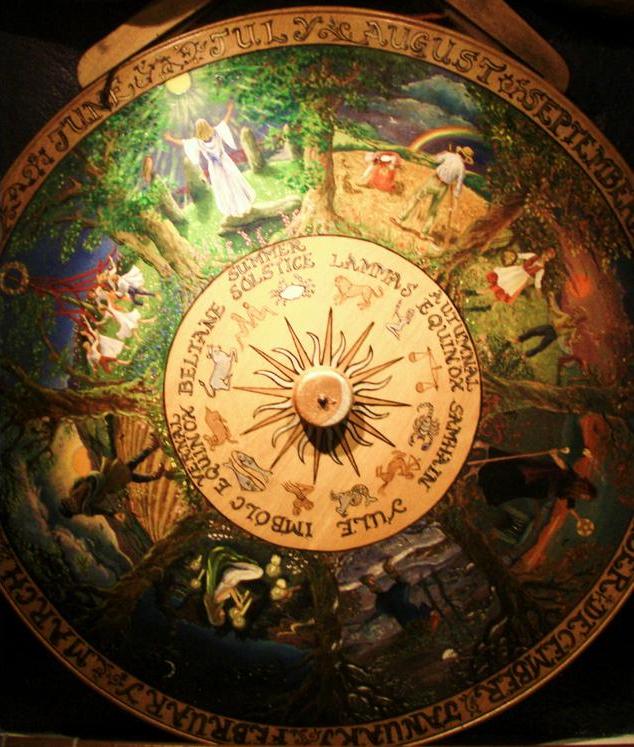
Many belief systems, especially Pagan ones, either see existence as being cyclical or incorporate some ideas from this basic concept.  An example of this  which is usually given is the natural cycle of the seasons, which can be seen demonstrated in the modern contemporary interpretation of the wheel of the year. In Wiccan belief, the common narative for the Wheel of the Year is that of the Horned God and Goddess. Horned God is born from the Goddess at Yuletide, comes of puberty at the vernal equinox, impregnates the Goddess at Beltane, reaches his full strength at the summer solstice, ages at Lammas, and  finally, dies and passes  into the underworld at Samhain. The cycle begins again, as he is once again resurrected and reborn at Yuletide to continue the cycle. These narratives and observations are seen to be the microcosm of a macrocosmic truth which asserts that the universe consists entirely of such infinite life cycles, all important to the other in eternal change.

Seen from this perspective,  it explains the approaches surrounding death within such belief systems that hold to this cyclic truth. Death is seen here as a transition not a final end, a metamorphosis of sorts.  Just like one season transitions to another, rather than nonexistence, so to does the person who has died. Whether their destination is the underworld, some form of heavenly afterlife or to be reincarnated, is usually up to the individual belief system. An example of this can be seen in the Norse concept of the Ragnarök, where the world would be destroyed,  and be remade and repopulated. Not even the Gods would be immune to the hand of change in this event, which it was said would cause  several of the major Gods (including Odin and Thor) themselves to die because of it. Even the Christians, inspired by earlier beliefs, still hold that the Earth will be eventually judged, destroyed, and then remade into a new Heaven and Earth.

wheeloftheyear1

In modern contemporary culture,  this is however not the prevailing case, where such interpretations were challenged by the rise of philosophical concepts that arose in the Enlightenment period such as Secular Humanism. A product of the enlightenment age, Secular Humanism is the position that human reason, and philosophical naturalism, are the basis for morality and decision making. Whilst supposedly an essential part of secular humanism is a continually adapting search for truth, it rejects completely the notion that  spirituality is essential to the human experience and that truth can be gleaned from spiritual practice.

Whilst this did have the positive effects of freeing us from the dogma that was enforced under the bootheels of a militant christianity, in the end it would end up evolving into its own ‘naturalist’ dogma  of sorts which has gone on to have a profound impact.

The cyclic model was thus slowly replaced and eroded into a new model, that instead concluded that infact fact reality was a linear construct and not cyclical, progressing along a line with a definite Beginning, and a definite End, without necessarily leading to new creation.  This, coupled with the correspoding rise in antispiritual sentiment led to a repression of the former dissenting world view. With this scale the concept of death and destruction changed,  becoming final instead of part of a cycle. This resulted  in the confrontation with Nothingness and the concept of Eternal oblivion.

Faced with the meaningless of life and the concept of eternal oblivion, the philosophy of Existentialism was born, which posits that an individual is responsible for imposing their meaning onto their own lives in what is essentially, an apparently meaningless, insane and absurd universe. A world that began without cause, and will end without cause, with the only meaning in a  persons life being defined by the individuals themselves.  For many, this position leads to that of Existential Nihilism, where the intrinsic meaning given by an individual is not sufficient to replace the fact that life has no intrinsic meaning or value. It is well summed up by a section of text from “The Specter of the Absurd: Sources and Criticisms of Modern Nihilism” by  Donald A. Crosby. “Strut, fret, and delude ourselves as we may, our lives are of no significance, and it is futile to seek or to affirm meaning where none can be found.”

hourglass

When faced with such a bleak outlook, its not surprising such a taboo regarding death slowly seeped into western culture. No longer was it a  transitory stage, but the extinguishing of a person. It became something to be shunned, something to be not looked at or investigated, in a a way that ironically smacks of  superstitious fear. Don’t talk about it, don’t invoke it. By being out of sight and out of mind, the concept of Eternal Oblivion hangs like a spectre over many today whose only answer to it is that they ‘choose not to think about it’ and shove their heads into the sand in terror. From this, it’s also not surprising to see that in such modern ‘advanced’ cultures that things such as harmful live for the moment  lifestyles,  widespread ecological damage in the name of profit, and a false belief in transcendental technological salvation come about alongside sky rocketing suicide rates, amidst a growing cloud of unrelenting cynicism and depression.

However, Man is not cast adrift into life like a shipwreck survivor onto an island, who can only ‘make do’ with his woeful fate and  stamp his feet in anger and nash his teeth until death claims him. This thought is nothing short of modern psychosis. I hope one day people can see this, and that scenes such as these shown by the BBC from Georgia could occur in my own ‘fair country’ of England’, instead of being seen as some weird, alien ritual that we seem to be incapable of understanding.

I  wish I could express the same desire publicly as they do, I wish others could even approach the subject with seriousness and not disgrace the memory of their dead by forgetting they ever existed.

I’ m not holding my breath.

Some Useful Resources

Posted in Other with tags , , on May 12, 2013 by Sypheara

Hello there readers, following on from my post yesterday I thought it was prudent to post only a small, but very necessary update to the blog.

This update is a new page that can be found on the right, called Links. In the vein of the page itself, it was made to show some of the many sources that I have drawn inspiration from in my research and learning, from books, websites and talking to other pagans and occultists.

On it hopefully you will find some links to the most useful and interesting web resources I’ve managed to find which have been of great help to my own practice.

The page will invariably grow as I find more places and remember those I’ve shamefully forgotten.

Hope you all have a great day.

The Witchmark and Blood Offering

Posted in Paganism, The Path of Flames with tags , , , , , , , , , on May 12, 2013 by Sypheara

This entry is going to be more personal than the previous, and due to it’s nature I can’t possibly put everything into this post in an objective manner.

Yesterday was a very special day for me, as it was the day that finally, after several years of research and practice I went ahead with a very important work, one which seals all my initiatory work up to this point and marks the beginning of a whole new phase for me.

This work I speak of was planned awhile ago, with not a small amount of trepidation involved. For three years up until that fateful point several months ago, I had approached the Gods and conducted several works with them, mini initiations which  brought me closer to identifying their energies, and aligning myself to them as someone who felt called to interact with them.

As these initiations guided me to my current path, I slowly began to learn that a true sacrifice was necessary outside of these small dedicatory rituals. True initiation, one would say, into the path I was being called upon to practice.

It was then I came across the notion of the Witchmark within my own tradition. Whilst a quick google would probably indicate to the reader this ideacame from the idea of the ‘Devils Mark’, this is not the case. This ‘mark’ is a physical mark on the body which is believed causes a corresponding mark on the soul of the person who receives it, serving as a first true initiation. The mark itself takes the form of a sigil of some kind, usually a primary one, and it is usually tattooed or scarified into the skin. This is more akin to the beliefs held by many pagan people in the past, where marking the skin for similar purpose is  shown to exist across many different cultures.

I’ll briefly divert to explain an important concept to be able to understand the importance of this as far as my own tradition goes, and it touches a subject again many don’t like to talk too openly about.

This subject is using blood offerings. It’s important to note that my own tradition sees the bodily fluids of the practitioner as being vessels for not only ones own essence, will and spirit but also that of any entities which are working through that person in possession at the time they are extracted. When coupled with my belief in the importance of personal sacrifice in works with the Gods and the concept of ‘you don’t get something for nothing’,  i’ts easy to see why the necessity of using my own blood in ritual became obvious to me.

By using  blood as both tool and offering,  we give actual power through it into our workings. This is where my (albeit limited) knowledge and respect of folk magical traditions come to the fore and what it has to say on this matter; I do not believe that, as many modern day pagans and occultists do, that such components only have psychological value. I contend they have a very spiritual and physical effect from the workings I have done that makes it a vital component in the majority of workings.  This view is relatively unpopular in many circles today (pardon the pun), but is one that makes any discussion on the Witchmark vital to understand from my own perspective, and thus unavoidable in this post.

Despite this, the the leap between using drops of my own blood in ritual up to this point and actually going as far as to take the plunge and have my own Witchmark, the primary sigil of Hecate, tattooed onto my body was a large one. With the sigil in place, it would be impossible to remove it – or at least physically difficult and spiritually permanently scarring. As such, I deliberated for awhile before deciding to ask Hecate directly for a response. The response to that half thought of a question that night was immediate, as I was surrounded and penetrated by a powerful, overwhelming force that seemed to permeate my entire body. Taking it as a sign, I finally came to my mind. I’d take the plunge and go through with it.

Using my intuition to guide me, I decided that the Witchmark would be placed over the sternum enabling two things. Firstly, that the Witchmark was placed as close to the centre of the chest as possible, over the region of the heart, seen in many cultures as a powerful energy centre of the body in some manner. Secondly, that the Witchmark would be out of sight, preserving it as a esoteric tool and mark in respect, not ‘displaying’ it in a show off my ego to the world.

every once in a while in your life you reach a decision point. a crossroad leading left or right. you can not look far enough to make the perfect step, but you have to decide anyways. is it left or right? or even turning back?

So yesterday I found myself on ‘the day’ of getting it tattooed onto my body. At this point, before hand, I was glad I was fully prepared, mentally at least, to receive it. The actual process was more painful than initially expected due its location (I was actually encouraged to get it placed elsewhere first!), but in the end it was strangely enjoyable in its own fashion. I tried visualisation several times, with only a small amount of success due to the environment coupled with the distracting pain. I saw flashes of images and sigils, but nothing concrete that I could work with or record for long in memory during the procedure. I eventually gave up and just began repeating a small mantra to Hecate in my head whilst the ink was applied.

After it was successfully applied I got up legs shaking, feeling born anew. Although physically exhausted, both mentally and spiritually I felt indescribably  heightened and sharpened. My body, mind and soul felt like they were screaming with vibrancy. A day later the effect still hasn’t worn off, and I still feel ecstatic, and have dreamed vividly.

I feel honoured to be able to receive this mark as a gift, and make that blood sacrifice in return as a sacred offering to Hecate which is the first step in a new direction on my journey. I hope to explore the paths unlocked by this sacred key, and share what I am able to.

With this being new territory to me, I thought it was more than worthy of a mention on the blog. I hope this post has been interesting and potentially shed some light on why it is seen as a necessary to my own path. I wish I could post more concretely about my own experience with it , but with it being such a new development I cannot really say much more as it would be a fabrication.

As a parting note, I’d like to say that I found an excellent post by another guy on his own similar experience which can be found at the following link, that shows anothers point of view on the subject. Whilst I don’t usually relate to many of the posts that go up on this site, this one definitely caught my eye.

http://www.witchvox.com/va/dt_va.html?a=usla&c=words&id=15349

Thank you as always for reading.

Syncreticism: When is it useful, when is it hurtful?

Posted in Occultism, Paganism with tags , , , , , , , , on May 10, 2013 by Sypheara

So I’ve been mulling over the next topic to bring up.. and this important one popped into my mind. As someone who worked primarily as an eclectic in some sense until relatively recently, it was always something that I continually took to be a subject of high importance as I approached my workings.

Syncreticism is best and most quickly described as the ‘Reconciliation or fusion of differing systems of belief, … , especially when success is partial or the result is heterogeneous.’. This  means in the terms of Paganism and Occultism the combining of different spiritual beliefs, and often actual practices, of  various traditions at the same time into a new form.

Commonly, these traditions are originally discrete practices or currents,  unconnected in any manner, separated often geologically, culturally and temporally, but slowly became incorporated into each other over time. An example of these types of hybrid beliefs which can grow from the merging of two forms of belief are possibly best found in the New World. Here, a myriad of  religions exist which arose from the combination of multiple belief systems. An easy case to point to would be something like Santería, which is the result of a  mixture of Yoruba, Native American and Catholic belief systems.

In modern Pagan and Occult circles, it can be often seen that there are high degrees of syncreticism, no doubt as the result of the easy access  to information caused by the coming of age of the internet. Whilst some of this works, and works well, other examples (which I won’t point out as causing offence isn’t the sake of the blog..) clearly does not, and in my opinion causes more harm than good.

So where do we draw the line? Whats helpful, and whats hurtful? Unfortunately, drawing that line is  on a very case by case basis.

A low level syncretic approach I would argue is vital. The search for analogues of your own practices and beliefs in other, differing currents allows for an insight that would otherwise be lost. Looking at other currents allows for each practitioner to potentially see where it intersects with his or her own teachings, which in turn allows for the revelation of new ideas and relations which may have, in a broad sense, have an enriching effect on their own beliefs and practices.

In this way, the philosophical insights from those other currents can be incorporated into ones own and potentially allow for its expansion and growth by challenging, confirming, or placing a different light on ones own beliefs.

maxresdefault

As soon as we begin leaving this territory however, things become much murkier and difficult to assess. When it come
s down to taking different rituals and mythological/theological ideas from different currents and combining them into a new form that utilise this ‘home brew’ , I would argue there is a very large possibility of utter disaster if it is not thought through with the most utmost care.

Even very ‘similar’ currents on the exoteric level can be significantly different on the esoteric level, causing  substantial problems in the long run. In the best case where two mostly incompatible currents come together, one element becomes dominated by the other, and becomes passive, having little effect in enriching the original tradition.  In the worst case however, the new combination just serves to show extreme disrespect to the currents being ‘forced’ together, and will either be entirely ineffectual or even harmful to the practitioner/practitioners who utilise it. The last is most likely to come from attempting to combine two very disparate belief systems.

An example of this to make the point clear is that, as someone who works with Hecate I would never use the name of Kali or Inanna for example within my tradition. Although connections between them exist, and one could even make a convincing argument that they are faces of potentially the same force, it would be wrong to use them within a ritual context as each face comes also with its own individual signature which marks it as its OWN current. This signature is influenced by the culture, and time period, it was originally conceived within and will undoubtedly come with additional influences which do not allow for them to be combined within the same working or potentially even the same framework.

The exception, I would say, is if the practitioner of a current was told otherwise through direct spirit work, with his or her Gods  or equivalent. Such instruction, if from a genuine source, should not be resisted as multiple, new, powerful ideas, concepts and paths have arisen from this process.

In conclusion, I do believe that overall Syncreticism is a highly important part in what makes Modern Paganism and Occultism feel alive and dynamic. It has definitively enriched my own practice, which will be seen throughout my further blog posts. However it is something that must be approached very carefully, with proper thought given to the above considerations without haste, recklessness, and disrespect to the traditions involved.

A Warm Welcome

Posted in Luciferianism, The Path of Flames with tags , , , , , , , on May 7, 2013 by Sypheara

Well here it is, the blog I thought I’d never make. I don’t usually enjoy talking about myself or my practice, due to the baggage that it inevitably brings, but after much encouragement I finally decided it was time to bite the bullet. I hope many of you will enjoy what I have to share!

Firstly, I have completed a basic about page which can be found in the navigation box on the right. For those of you who don’t personally know me, I hope it will suffice as an introduction as to what this blog is about and my own personal experience up to this point on my path. It was alot to try and fit into a reasonable word count, as I believe it’s important for people to know my general background to find what I write more approachable. I don’t like pretentiousness or the focus on the individual over ideas which can be the case within the Pagan/Occult community in some places, so I hope it comes across as frank and honest as possible.

Many of you may be wondering why I have chosen the name The Luciferian Revolution for the blog. After all, isn’t this a blog on Pagan things and clearly Lucifer is a christian construct and idea?

A valid question I would say. The long answer would be too long to explain in the introductory post, but the short answer is a definite no.

Lucifer was the name refering to an earlier Roman/Greek concept based around the gods Phosphorus and Hesperus, themselves personifications of the morning and evening appearances of the planet Venus. Phosphorus was simply the name for this planet, which translates to the morning star or dawn star. This is turn, like many other Pagan concepts, became demonised by the Christian Faith via association with the concept of Satan, due to Satan himself being described as the ‘morning star, son of the dawn’. Satan, a concept and story itself influenced by syncreticism with earlier Canaanite and Babylonian ideas of gods/goddesses descending from heaven to journey to the underworld, thus became forever attached with the name Lucifer.

As this clearly illustrates,  the concept of Lucifer is clearly one that belongs to the Pagan sphere. In addition, as we will see, the Christian influence infact only  served to reveal more aspects to an entity which exists far outside and separate of it, with many faces of its inherent nature being revealed across many belief systems in different forms.

For explaining the name of the blog, it’s easier to simply explain that for my path, Lucifer is in every sense of the word, the light-bearer, the ever living fire, and counterpart to the coolness of the void. To us, Lucifer is the highest point of the cosmic tree, the supreme torch bearer of divine wisdom and the ruler of the ever burning fires of Thaumiel.  He can be seen as our “Prometheus”, who was born from the womb of the Dragon to bring to man the spiritual fire which animates and empowers us.

It is believed in my Path that the world has entered a new age, or aeon, in which the Gods themselves will initiate the return of  true spirituality to mankind. This is a spirituality that will do away with the nihilistic skepticism, and dogmatic, controlling religions of the current age which together, in their own ways, only serve to disconnect individuals from their own spiritual path and the Gods.

This knowledge, coupled with the works being produced currently alongside the resurgence of interest in the areas of  paganism and the occult  shows the signs of a coming true Luciferian revolution and the freedom it will bring along with it.

With this in mind, I thought the name of the blog was more than fitting.

Under construction..

Posted in Other with tags , , on May 6, 2013 by Sypheara

‘I need no more brightness :
I am the night and the shadows,
I am the field when pain is the seed.
Flores noctis sumus atque alas pandimus,
In profundis tenebrarum.
Solus halitus emanans penna speculae,
Quam expellit folium mortis.
Shatter the stars,
Drag out the light,
And drown it in the deepest seas of my mind’

Actual content coming soon….